
Author Archives: Woodsbum

The Swedish M39 Rucksack – Mods

by Woodsbum

The Swedish M39 rucksack goes almost hand in hand with the whole “bushcraft” craze. It is leather and canvas, a definite favorite among bushcrafthers, and holds just enough gear to allow for a comfortable weekend or day outing. It has straps to carry a bedroll or wool blanket. There are straps on the side to carry an axe. It even has a separate pocket inside that stores your cooking gear quite nicely without getting all sorts of soot on your other gear, assuming that you cook over an open flame as I do. All this in a simple, inexpensive, extremely sturdy little “pack”age (sorry about the pun…  been a long week already).
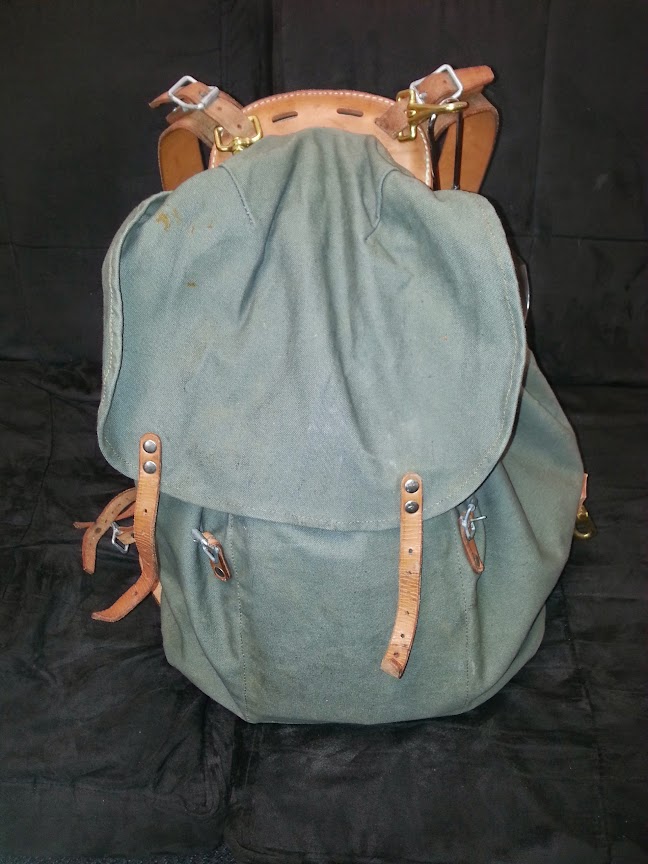
Swedish M39 Rucksack

Swedish M39 Rucksack

There are several short comings to this pack, however. Most of which revolve around the suspension and straps. The shoulder straps are adjusted by buttons that slip into slits that are cut into the shoulder strap itself. The bottom part of the shoulder strap is supposed to hook under the waist belt to give a more uniform ride of your pack when under heavy load. There is the problem. Not only does this button dig into your shoulder, but the clips to hook onto the waist strap are not long enough to reach for most normal sized people. The waist strap itself is made for someone with a 30 inch waist as well. This makes it impossible for people my sized to even use the stock system.

The frame that the pack uses has a riveted in leather lumbar strap. It also is made for a 30 inch waist person. To turn this pack into a comfortable system for the average American, the frame must be bent and tweaked. What I did was probably the easiest. I took a hammer and a block of wood to carefully bend the pipe frame into a more reasonable shape. You need to use the wood block as a forge and then open up the arch by hitting the frame at the apex. It will flatten out the frame and thus make it fit bigger people.
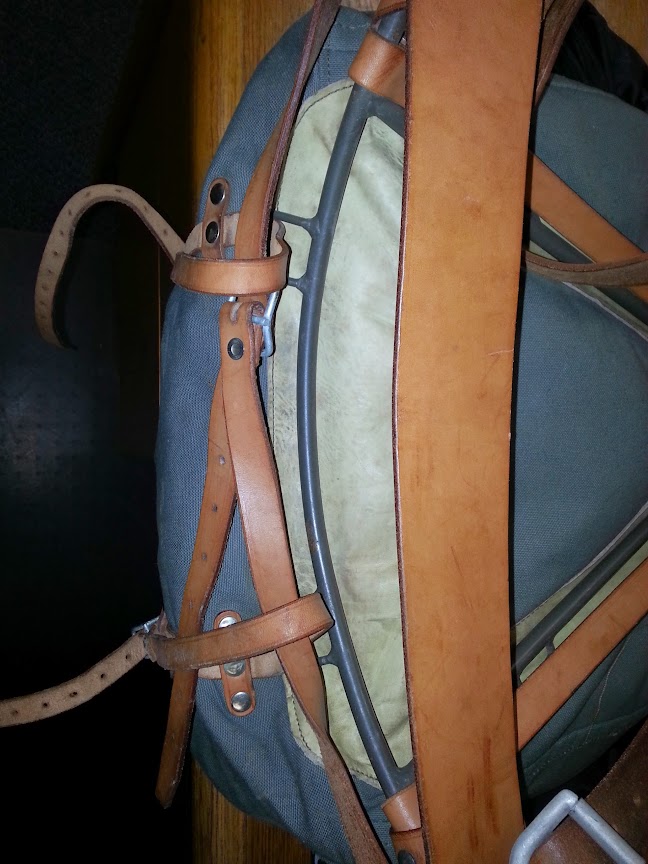
Flattened out arch of the frame

Flattened out arch of the frame

Be REALLY careful, however. The frame is a hollow pipe and does break if you are not careful. I have had to weld one already due to over jealous pounding on the frame.

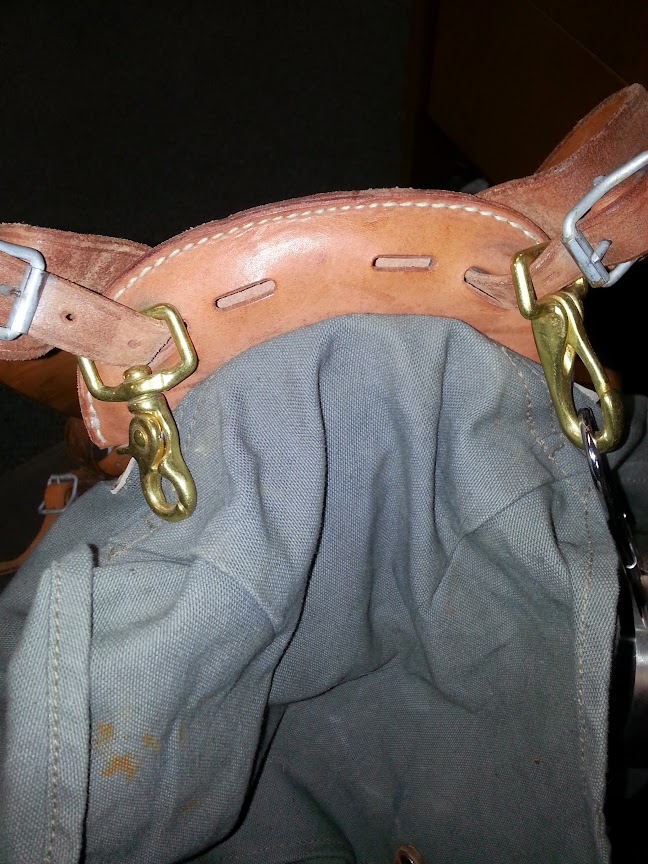
To fix the crazy button shoulder adjustment issue some cutting and stitching is required. What I did involved stitching a D ring into the cut strap and then used the waist belt hooks to make quick disconnects. The same straps are used. Nothing new is introduced. The only difference is that the hooks that were originally designed to attach to the waist belt are now being used on the bottom shoulder adjustment straps. It is very clean and functional as a quick disconnect.
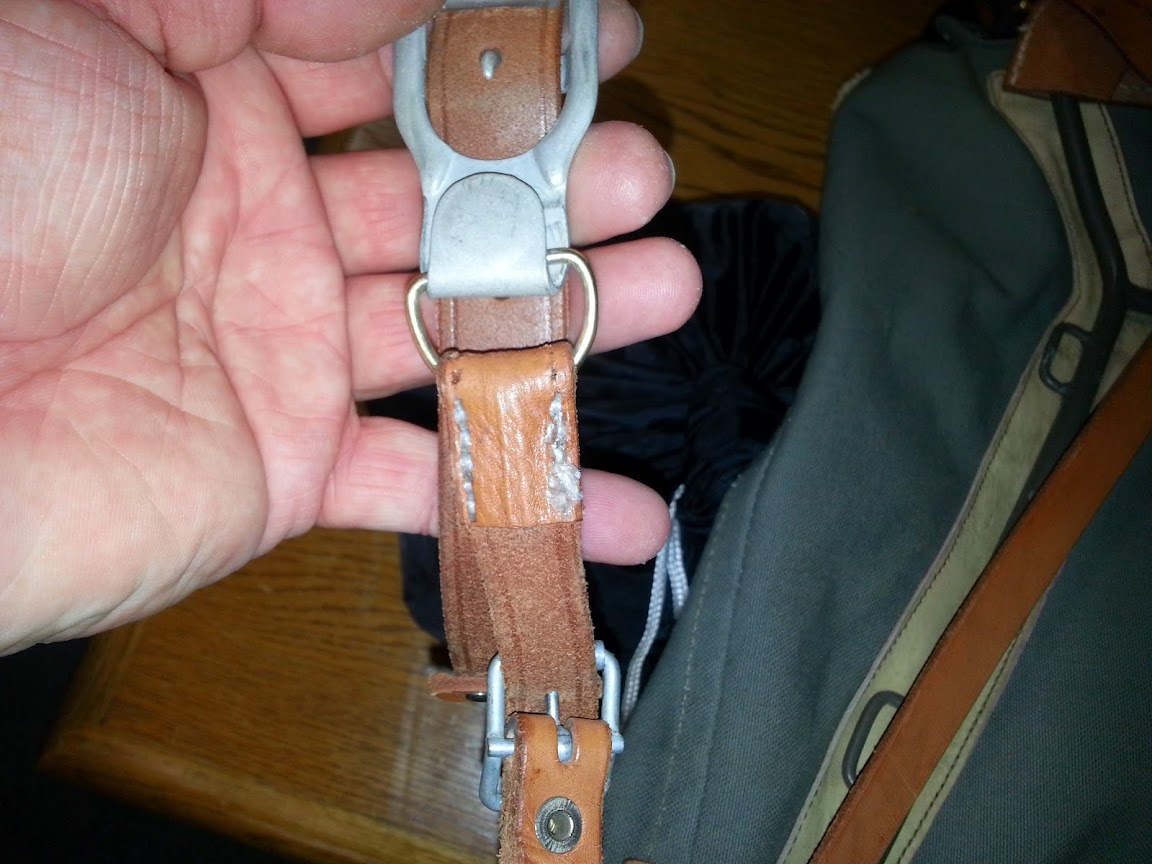
Quick disconnect for shoulder straps
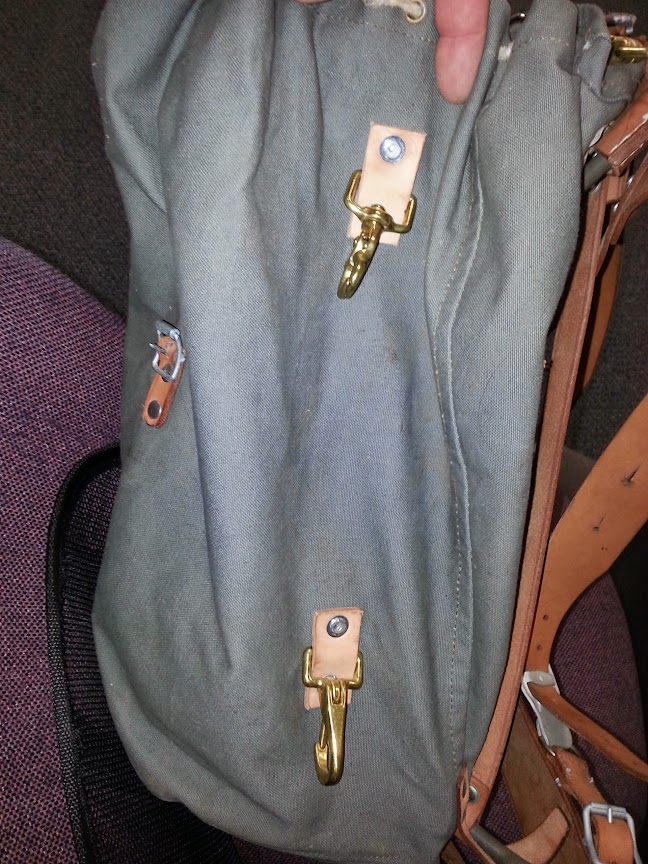
Quick disconnect for shoulder straps

I also added some attachment points on the side so that I can attach a quiver. I can now put my takedown bow and arrows in my quiver then carry them attached to the right side of my pack. It also gives me easy access to my arrows for hunting purposes if using one of my traditional bows.

Quiver attachment points

Quiver attachment points

At the top of the pack I ran some hooks through the existing suspension straps. This provides me with a way to attach my pans, pots, cups, etc., or any other item that I want quick access to that has a carry strap or eye on the handle. As you can see in some of the pictures, I put a handled cup/ladle thing on mine. This is just big enough to cook about anything I would want along the trail.

Hooks

Hooks

Last, but not least, I also found that one of those spring stop clips on the internal draw string helps immensely. Of course I tie it up before I start hiking, but getting that knot tight is sometimes a chore without this plastic stop.

This is a highly recommended pack and if you would like to see some more detail in what I did to this baby, just leave a comment. If you have one of these packs, I think the pictures will explain about everything I mentioned without too much confusion. Don’t forget to check out some of my other gear reviews and mods while you are here.

  • Share on Tumblr

Tactical vs Hunting – Stance and Form

by Woodsbum

After having taught numerous Hunter’s Education classes, hunted around those new to the sport, and worked with countless people that are getting ready to start hunting at the range, I have found that there is a definite pattern. Those students that have taken tactical shooting classes and stick to those stances are at a definite disadvantage in the field. The tactical stances allow for great forward and lateral movement. In a hunting situation, however, most movement is based around a pivot foot. The tactical stances do not seem to allow for that pivoting movement and thus limit the field of fire and flight tracking needed to be effective while hunting.

As a way to better explain how I came to this conclusion, let me give you several examples.

Example 1: Several of us went out dove hunting. All of us “old school” stance users had no problem in getting our limits within only a few hours. A couple of LEO were also out there and were using their “tactical” stances. They had no problem hitting the birds that were flying in line with the way that they were facing. When a bird crossed their path, however, they could not effectively track it without having to physically pick up both feet and move. The stance just was not effective when it came to that swing movement needed in bird hunting.

Example 2: Skeet shooting at the range. A couple of prior military and current LEO persons were just stacking the slugs into a target one on top of another. They were obviously quite proficient and had practiced this a lot. When the range swapped over to skeet, they were both completely unable to track the clay. Their feet were moving around so much that we started giving them a hard time. We told them to, “Quit dancing and just shoot the clay.” Both were less than 5/25 and they admitted that they were never able to get into a good position fast enough to shoot skeet.

Example 3: Working with new hunters in the field. It never fails that when I work with new hunters that those in the tactical stances can not hit flying targets effectively. One such outing I saw this guy hitting everything set in front of him with slugs or buckshot. Not issues. Once we swapped to bird shot and tossed something, he missed almost every time. Even when I tried to help him and correct his stance, the way that the arms are positioned in a tactical stance really hindered his ability to transition over to hunting type situations.

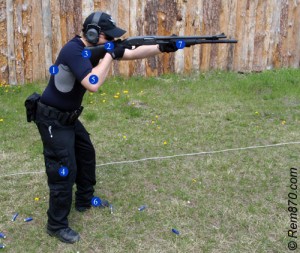
So everyone can see the difference, here is the stance I am talking about.
shotgun_shooting_stance_scheme

This stance is more squared off toward the target. Some people even square up completely with both shoulders completely perpendicular to the target. This disallows much twisting at the hips while keeping the firearm placed properly on the shoulder. It also does not allow for decent twisting motion because you weight has to be evenly distributed. You have to shift your weight, move a foot, and then redistribute your weight. Even the LEOs that I saw had to make that same movement to try and track objects flying across their path. This made their “swing” that is required for leading flying birds uneven and jerky.

A more traditional hunting stance is more like a boxer’s stance.
ch7_015_NJ

This stance allows the hunter to simply transition their weight to either foot and spin on the ball of their foot, thus smoothly tracking the animal during flight. Think of the movements that boxers make. Their movements are smooth, quick and they can easily track their opponent.

Now I know that not all people bird hunt or will bird hunt. The principle holds true with all types of game, however. The tactical stance disallows for decent twisting or sweeping type movements where game crosses your path. The hunter would have to twist more at the knees than waist for those wider, sweeping motions. Having witnessed it first hand on multiple occasions, it really is a difficult maneuver to properly sweep smoothly.

Here is your test: Pull out your trusty firearm and try it yourself. Get into one of the many tactical stances that are taught. Square your shoulders up so that your chest plate properly covers your vital organs in case you are hit. Then try and move in all the manners required while hunting. You will quickly agree with me that you suddenly become like a rook on a chess board. Great forward, backward and lateral movements, but you will have little sweeping movement. Next get into that boxer type stance that us “old school” hunters use. There is very little decent movement allowed except for sweeping motion. Forward and later is more of a crossover step or a shuffle. Not very effective for finding cover, but great for tracking game.

This leads me to my final conclusion: If you are a tactical type guy, have fun. Do your thing. If you do the tactical stuff for those SHTF type situations (prepper type stuff), you really need to include some hunting type education to be well rounded. Hunters in their “old school” stances are not going to be running up on something while firing. It would be more of a move, fire, and then move type situation to be effective. Either way, learn both and become effective with both ways to fire your weapons. You never know when you might have to adopt that goofy looking target stance to shoot a deer out at 700m while standing…..  Now there is one more to learn, so get out there and practice PEOPLE!!!!

  • Share on Tumblr

LaserLyte Kryptonyte Green Lasers

by Woodsbum

Well, I have been depending on Gunguy to put up posts for me as of late due to some SERIOUS house modification/renovation taking place. By “taking place” I should reference the fact that I am doing it all…. A few friends and relatives have kicked in, but the time on my roof and slinging nails wildly takes away from my ability to get out and give you any new bushcraft type posts. I have, however, had the opportunity to install and play around with a few really nice items that I procured recently.

Enter the LaserLyte systems that I picked up for my wife’s and my AR15’s. I picked up one of the LaserLyte Carbine Green Laser Systems for my wife and I got one of the LaserLyte CM-15 Center Mass Kryptonyte Laser Sights for myself. For the list price versus the actual price, I was a bit concerned as to the quality of the laser. When they arrived, I was even more concerned because the packaging was not what I expected. It was in a simple plastic package that made me a bit more skeptical as to whether I had spent my money wisely. For $300 list price, I was expecting a box at least.

When I took it out of the packaging, the quality seemed much better than I begun to fear. The unit is solid and actually looks like it will take some abuse, but I doubt it is on par with a Vortex scope. Only time will tell on that one. The installation is quite simple and I found that the screw on covers for the adjustments do feel sturdy and of decent quality. I was, however, a bit annoyed that sight adjustments must be made with an Allen wrench. They do supply the correct size, but it is going to make field adjustments that much more difficult if I have to keep track of a small Allen wrench.

Both models are the same quality and have, thus far, not had any problems with being bumped around and dropped repeatedly after installation. While I still had a warranty, I wanted to see how durable they actually were before I got to the point where I would depend on them. Again, they are surprisingly durable.

In regards to the important part, the laser itself……  Wow. The carbine laser is very easy to see and is dead on accurate up to the 100 yards that we tested it at. The “Center Mass” one was not as visible and is definitely built for a shotgun. The pattern is very sweet, however. I will be replacing this with the Carbine model for my AR and putting the Center Mass on my Mossberg 500. That should be fun.

Laser Pattern for Center Mass

Laser Pattern for Center Mass

Several reviews from Amazon have stated that they quality was not worth the money and the laser system breaks after only a few rounds. We put 7 30 rounds magazines through each of our rifles. The sight did not deviate from where it was originally set, there was no cutting in or out of how bright it was, and there did not seem to be any issues to speak of. We will keep our eyes on the sights and make sure nothing bad happens. If it does, I will post it and link to this post.

All in all, the reduced price for this laser makes it worth the money. I don’t think that the original list price makes this a decent value, but around the $150 mark it seems reasonable.

  • Share on Tumblr

KEGERATOR!!!!

by Woodsbum

This post isn’t very backwoods, gun, or gardening related. It is however AWESOME!!!!!

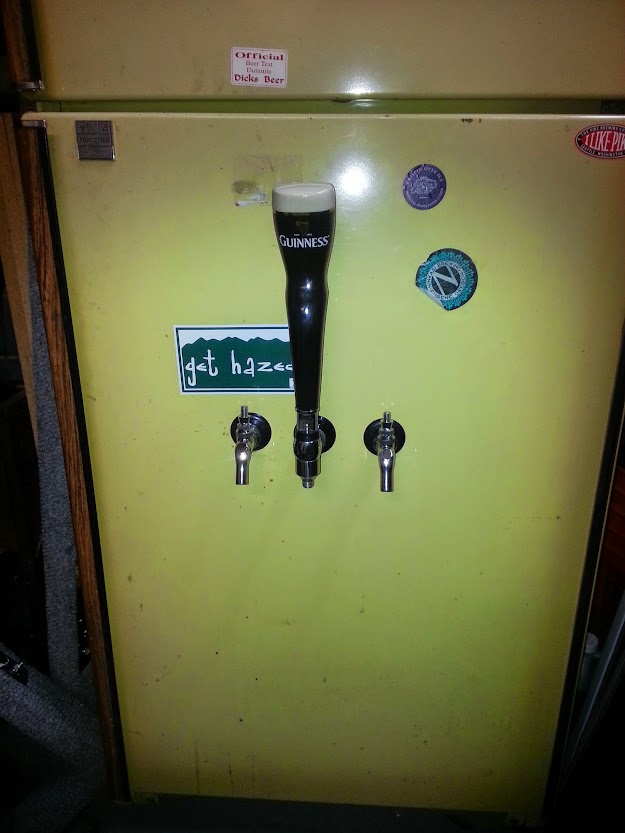
After many years of putting it off, I finally did the work needed to get my kegerator up and running. As you can see from the picture below, I will have two CO2 beers and one nitrogen beer on tap. There are a few pieces that I am still waiting on to arrive, but for the most part I am done with all the hard part.

The beauty!!

The beauty!!

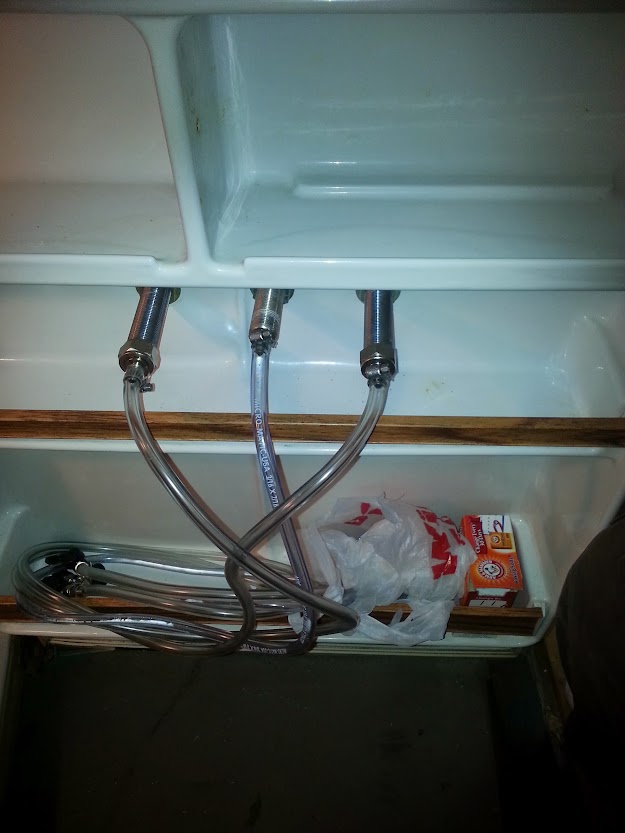
The refrigerator was given to me by my brother a while ago. It ended up quitting me for about a year. I then REALLY examined the wiring and found that all I needed to do was tighten a connection. Been working ever since. There was already one hole drilled and a pretty worn/nasty spout installed. He also ran a CO2 hose through the side, but was down in the corner so that kegs could very easily pinch a line. I did a few modifications to make it my own (read as BETTER!!!).

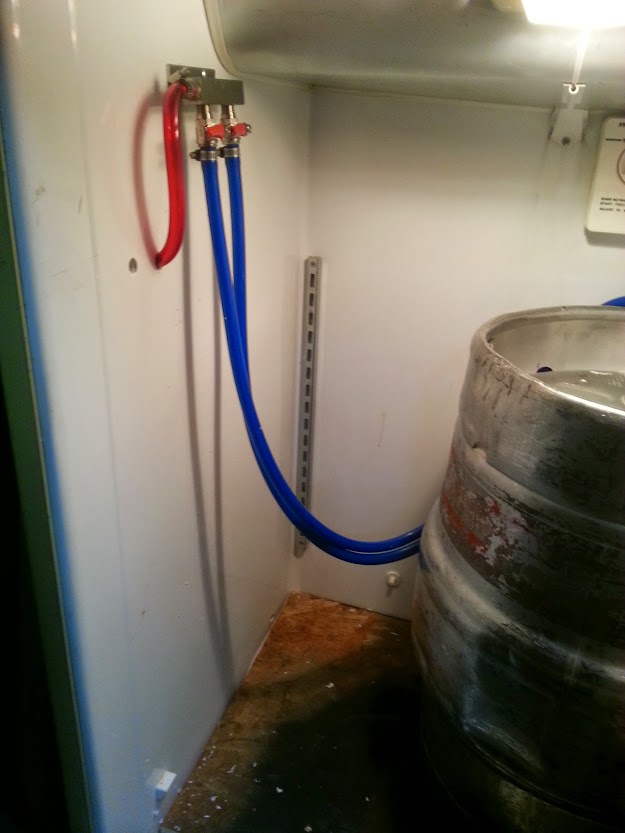
CO2 lines installed.

CO2 lines installed

As you can see, I installed a manifold for my CO2 so that I could run two beers off the one tank. I color coded it so that it would look nice as well. The second hole you see is for my nitrogen lines. That, my CO2 regulator, sankey coupler, and spout for my Guinness faucet should be here today. It was tough, but I drilled the hole just barely big enough for the hose. I did this so that it would stay nice and tight without me having to squirt expandable foam all over the place. I also built a floor for the kegs to sit on out of some scrap wood I had laying around. This has helped keep things in place as well as protecting the bottom of the refrigerator from the kegs as I swap them out.

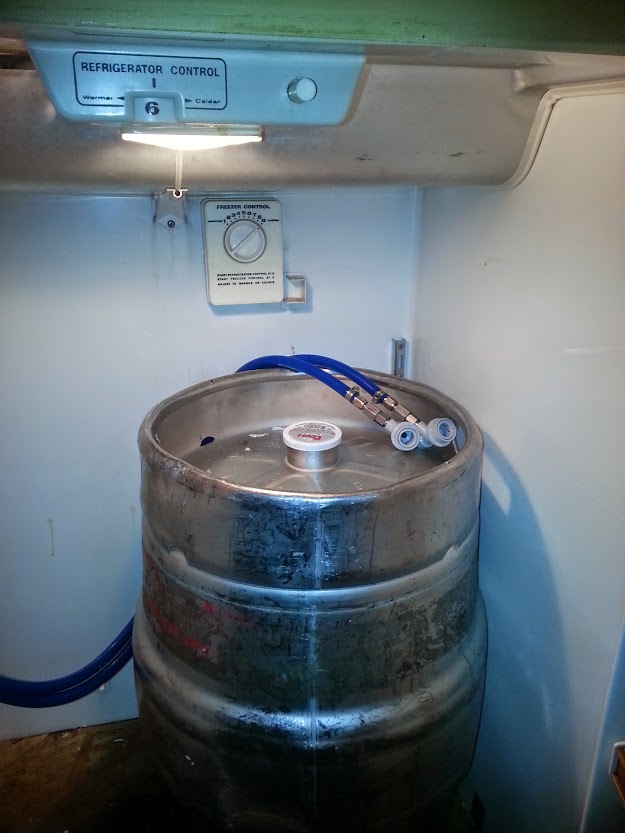
Ball locks on gas lines.

Ball locks on gas lines.

Another thing I did was for ease of swapping couplers and kegs around as I changed out beer. If you look, I put ball lock keg fittings on all my gas lines and I put sankey to ball lock quick disconnect conversion kits on my couplers. By doing this, I can easily swap out between American and European sankey couplers, “M” couplers, or just use the ball lock system for homebrew in corny kegs. It gives me much more freedom in my beer choices. I also did this for my nitrogen system so I can swap in the same fashion. This means that I can use my Guinness coupler (U coupler), sankeys or hook up a corny there as well.

Beer lines to my shanks.

Beer lines to my shanks.

I did the same thing with the beer lines. You can see the ball lock connectors in the door tray. I put the Guinness between the two Perlick faucets so that it wasn’t as odd if I was not running all three beers at once for whatever reason.

To drill the holes, I used a 1/2 inch hole saw. They are about $10 from Home Depot for a good one. It really wasn’t that big of a chore and it really came out well.

The faucet handle situation does need to be rethought a bit. The actual tall, bar style handles I have don’t fit correctly where I have the spout. The handles hit the door and thus don’t close out the faucet properly. This is a serious problem and I will have to do some thinking about how to fix this.

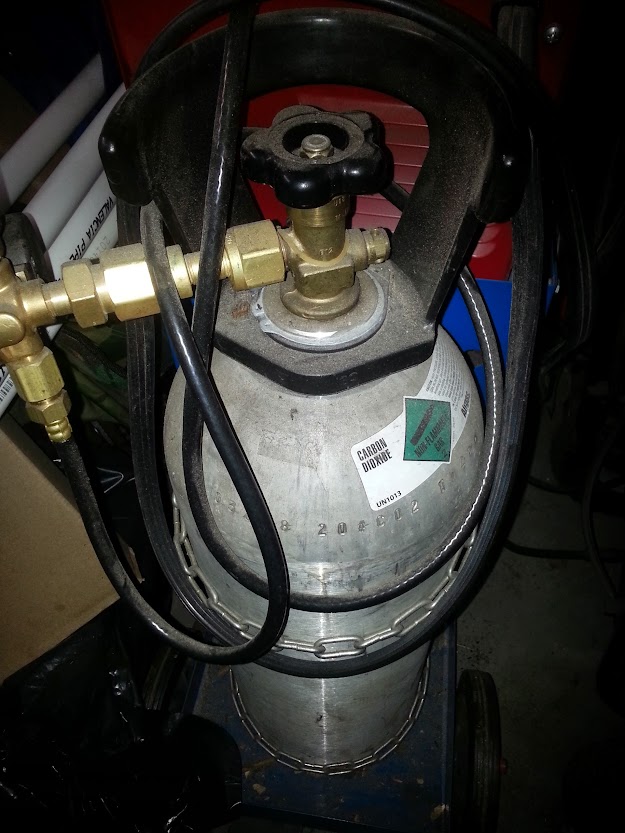
Since I already have my tanks and such, I will end up building myself a tank stand/holder to keep them safe. My CO2 tank actually was originally a soda machine tank, but I reallocated it for a while to do some welding. It already has food style CO2 in it, so hopefully my welds don’t get sick since it wasn’t a welding mix.

CO2 tank

CO2 tank

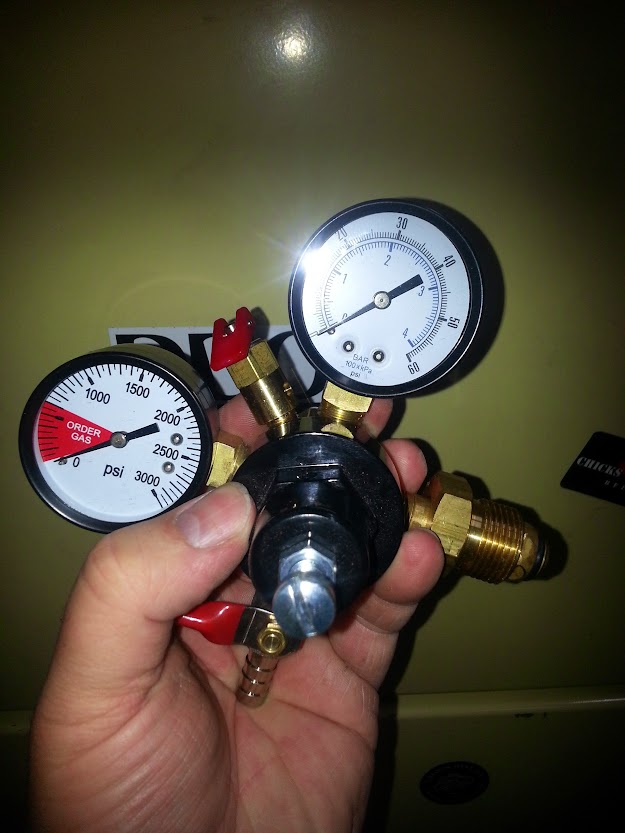
Like I mentioned, my regulator for this will be here today. My nitrogen tank will be ready today as well so I can hook up the lines and this bad boy!

Nitrogen regulator

Nitrogen regulator

I was a little surprised by the differences between CO2 and nitrogen regulators. Notice how the second gauge goes all the way to 60 PSI? Guinness for instance should be run around the 30 mark from what I have been told and have read. It will be a fun experience to “test it out and drink the practice runs.”

Since I have not decided what to do for a drip tray yet, I will have to also do some thinking there. I have been considering re-purposing something completely obnoxious for the task, but can’t find anything worthy as of yet. There is no doubt that I will think of something, however. I might just weld up something out of steel. We will have to see.

If you decide to do your own kegerator, do yourself a favor and do it right from the beginning. I have seen many that were done in a haphazard fashion that were just given away a while later because it didn’t fit the person’s needs. Spend the money for the right parts and just get it done.

Happy beer drinking!!!!

  • Share on Tumblr

DIY Tobacco Pipes

By Woodsbum

For a long time I was very partial to cigars, but was not pleased with the incredible price that a premium cigar would command. Eventually, I picked up smoking a pipe instead of a cigar while out in the bush. Not only are pipes easier to carry without crushing everything, but more important to my wallet is the price for tobacco. It means that I can smoke just as much as I want without wasting an entire cigar if it just doesn’t hit the taste buds properly.

Now a good pipe can cost in excess of $100 and can just skyrocket from there. Because I have something wrong with my cranial wiring, I always think that I can figure out a way to do as good or better……   Enter a post on BushcraftUSA that discusses building your own pipe.

In the post, the guy “SkogKniv” who now is known by his real name of Leif, there is a method of drilling out the center pith of a tree branch so that it can be used as a pipe stem. Once I started playing around, I figured out how to drill out some very long tree branches to make myself a homemade pipe.

Getting the right materials and tools together is always a chore. Knowing that the hardest part was going to be drilling the stem, I decided to start with that part first. The first hurdle was to find the right wire for drilling. I went through several types to include coat hangers, tie wire, hanging wire for pictures, gardening wire, and several others. What I found to work best is 16 gauge stainless steel wire that is sold at Ace Hardware and Home Depot near all the fasteners. It is the perfect combination of flexibility and durability so that it won’t bend or break off during the drilling process. The next thing you will need is one of those cable, survival saws. They have the key rings on either end that you put your fingers through and it is made of a rough wire material. Lastly, you will need a good drill.

What I did was just like the post describes. I rounded out the end of the wire, chucked down the other end, and then started drilling through the center of the stem. It took a little bit, but wasn’t as hard as I thought it would be. I then cut the end off the survival saw and used that to clean out the inside of the stem I drilled. It worked just like sandpaper. With a little maneuvering and manipulation of the saw, I was also able to taper the ends of the stem so that it looked cleaner as well.

Here are a couple things that I learned:

  1. Don’t pick a dry stick. It needs to be green.
  2. Don’t pick a stick that has any twigs growing out of it. Those cause a knot in the stem that you will not be able to drill through very well.
  3. Make sure you hold and guide the wire as you drill. Otherwise it will bend in the middle and slap your finger nail completely off….  Don’t ask.
  4. Trying to do it all with a wire as opposed to sanding with the saw will only get you a mouth full of sawdust.

Once you get the stem drilled and ready, all the rest consists of is:

  1. Drilling the bowl. Use a drill press and some decent bits. I like the 3/4 inch bits from Harbor Freight.
  2. Drill the hole for the stem to press into. Measure it out and pick the right sized bit from there. Make sure you drill so that it will be just below the hole you drilled for the bowl.
  3. Dremel out a small hole to attach the bowl to the stem hole. This is called the draw hole. I like using the wood carving bit in my Dremel and making a little channel as well as the hole. It makes the pipe smoke better.
  4. Sand and wax with carnuba wax, then polish.

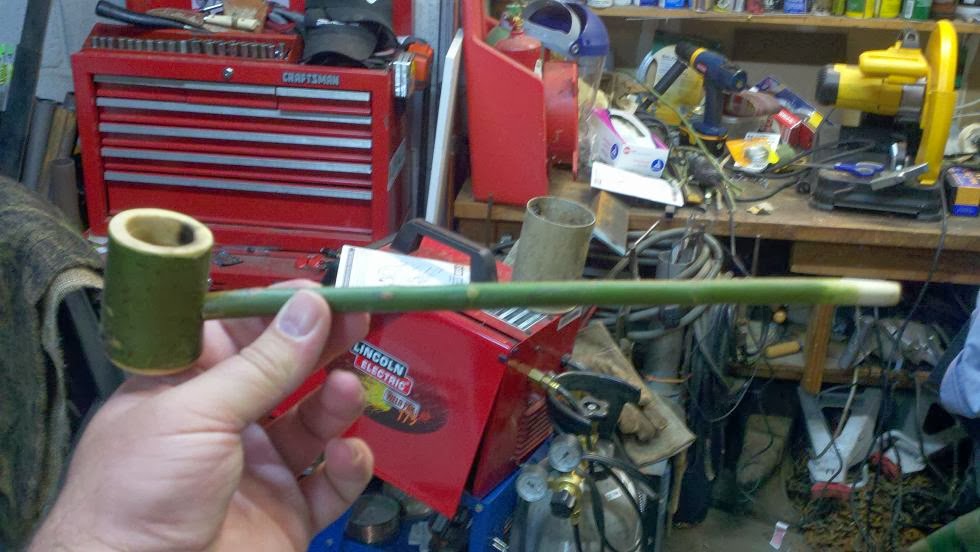
It really is almost too simple once you get your stem drilled. Here are a couple pipes I have made.

Homemade pipe

Homemade pipe


Homemade pipe

Homemade pipe

Homemade pipe

Homemade pipe

Homemade pipe

Homemade pipe

  • Share on Tumblr