
Author Archives: Woodsbum

Food Dehydration – NewB Guide

by Woodsbum

To make life easier in my family, I finally decided to get a food dehydrator. “How would this make your life easier?” many will ask. It is quite simple: jerky……..

My family LOVES jerky and “snack” type foods. Not necessarily junk food, but snack type items. We love veggies that are cut up and ready to eat. Fruits that are cut up and easy to pop in your mouth. Popcorn is also a favorite. The absolute, top shelf snacking chow at our house happens to be beef jerky.

For those that are not familiar with the “jerky” world, it can become quite an expensive habit to have. A small package of Jack Links (our household favorite brand prior to the homemade stuff I did over the weekend) can run $10 for only a few minutes of taste bud Utopia. Couple that with the expensive dehydrated fruit that we get on occasion and a hefty bite can be taken out of your bank account. What we did was purchase this:

Excalibur Food Dehydrator

Excalibur Food Dehydrator

In only a few minutes of work and several hours of wait time, I ended up with some INCREDIBLE beef jerky. Here is how I did it:

  • Purchased a steak block from Cash and Carry, a local restaurant supplier that is open to the public. I got round steak for around $3 a pound.
  • I cut the meat into thin slices. Mine ended up between 1/8 inch to 1/4 inch depending on how steady my hand was.
  • The meat was marinated in Frank’s Red Hot buffalo sauce, soy sauce, lemon juice, liquid smoke, black and red pepper, garlic, and Tabasco sauce for 24 hours.
  • We set the device’s temperature setting to “Jerky” and the timer to 8 hours. about 6 hours into the process, we flipped the jerky over.

That was it. It came out delicious and we now have a great way to keep jerky in the house for a mere fraction of the price.

We also did some apples and mango. To help with the prep work and hassle, I picked up these from Amazon:
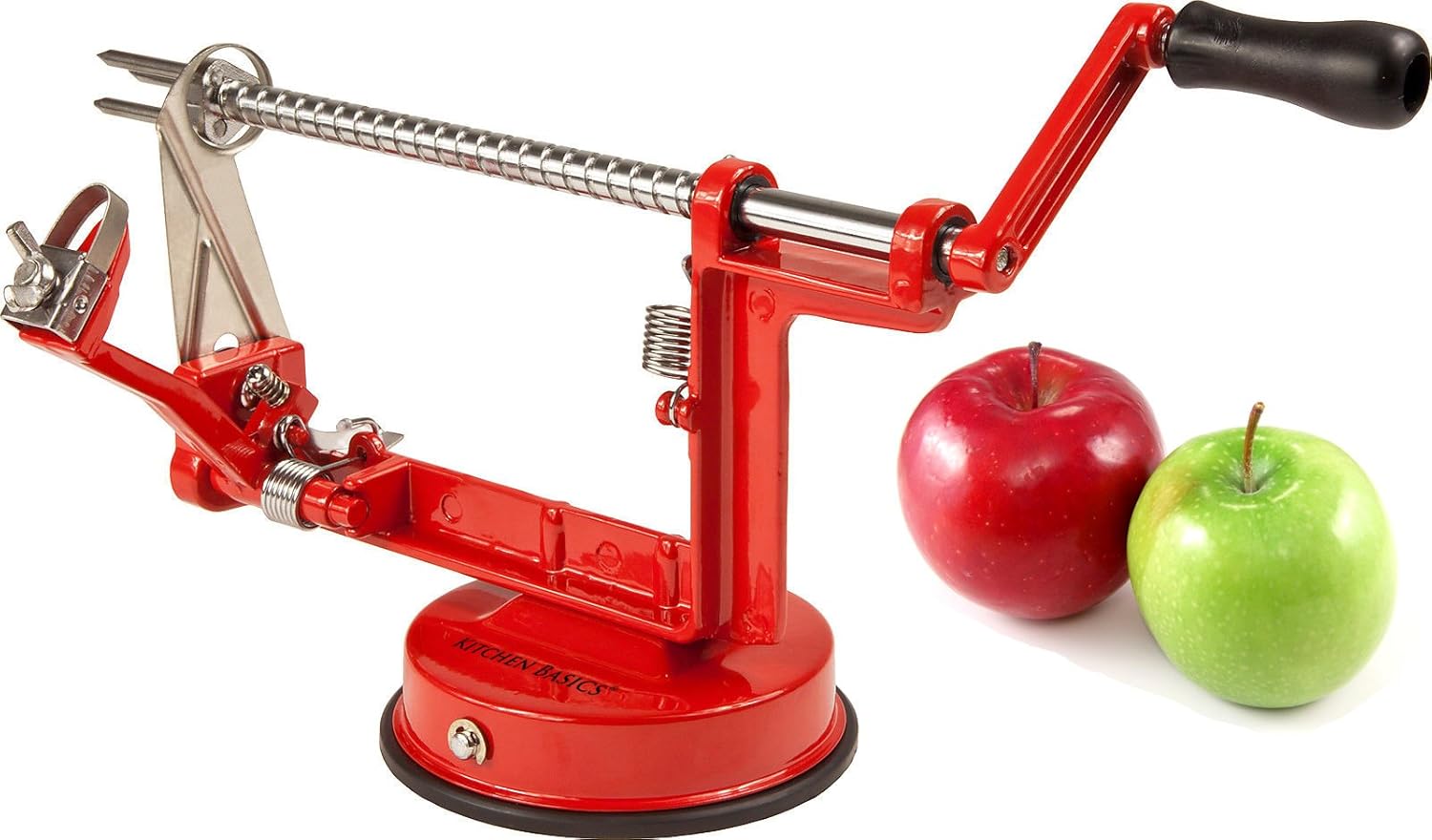
Apple Core and Peeler

Apple Core and Peeler

Mango PItter

Mango Pitter

These things made quick work of the fruit and allowed me to get it prepared and into the dehydrator in a matter of only 5-10 minutes. It was SO quick and simple that even my daughter was interested in at least watching, but not helping. This is definitely a step up from being completely ignored while doing things in the kitchen, so it must be really simple.

Once I got the fruit prepped and onto the trays, I sprinkled cinnamon and sugar on the apples. The mango was skinned, but left alone to dry. The drying process took about 10 hours for a good, complete dry. The product was definitely worth the wait, however. Over the course of 2 days the late teen/early 20 year olds in my home ate a full 1 gallon Ziploc freezer bag full of dried fruit. It was amazing and so very simple.

When I get home tonight, I will be prepping some more jerky and drying out some more fruit. As time goes on and I experiment with even more recipes, I will post them. The best combo for fruit I have found thus far involves a medium to heavy sprinkling of cinnamon and sugar mix. I will try more things, however and report back. Later on, I also plan on making some of my own backpacking soups from veggies and meat. We will have to see how it goes, but I have some faith in the process after having done the fruit and beef jerky this last weekend.

If you have any interest in getting into the whole dehydrating thing, I highly suggest you pick yourself up one of the Excalibur systems from the very beginning. The ease and simple design, the timer, and the even drying of the food really make it worth the money. This is definitely a recommended product. Also, let me know if you come up with some good recipes along the way. We get good, inexpensive produce so I can afford to play a bit.

Happy dehydrating!!!!

  • Share on Tumblr

Restoring and Hafting an Old Axe

by Woodsbum

Having a nice axe around is pretty important for the bushcrafting type person. Unfortunately, they get really expensive for a good one. The best brands (Wetterlings, GB, or a custom) all run over $100. Even though it is a great price when considering the quality of the item you are getting, it is still over $100. This is where being thrifty and putting in a little elbow grease can save your tail. By watching for vintage axes on Ebay, garages sales, or thrift stores you can get a top quality axe head that just needs a little TLC.

Take these three axe heads for instance. Two were given to me and one was purchased for $.50 from a garage sale. The carpenter’s axe and single bit are both True Tempers and the hatchet is a forged head from Germany. All are great quality tools that will give many more years of service if restored properly.

Three axe heads ready for restoration

Three axe heads ready for restoration

In the restoration process, the first real step is to get all the rust and patina off the head. Some people are really into the whole “vintage” thing and want to keep the product in an antique state for resale or collectible purposes. When you are going after a usable tool, you want to make it as close to new as possible, in my mind. This is why I get rid of all that and work to remove all the scaling, rust, and patina to get back down to a bare metal. There are several methods to do this. One is to use vinegar. By soaking an axe head in vinegar, the main rust and scaling will bubble off and be removed. It also, however, does what is called a “vinegar patina.” I am not fond of the look and it actually bugs me. The carpenter’s axe and the single bit above were both done with vinegar. As you can see, it darkens the metal and essentially makes all the rust pits more visible. The hatchet is getting a different treatment.

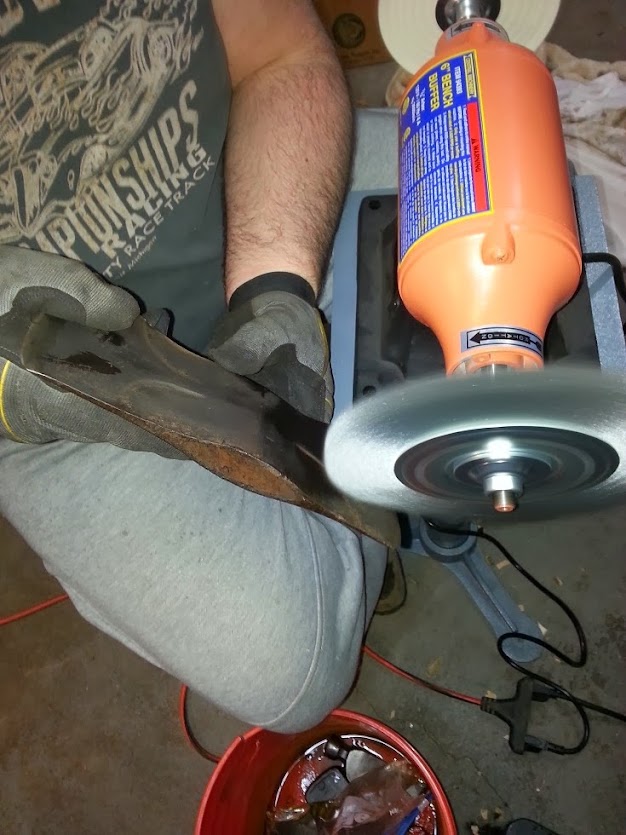
To clean off the hatchet, I soaked it in a strong penetrating oil for a week. I then took a wire wheel to it and all the nastiness came right off. Here are some pictures of a how well the wire wheel works on an old axe head. This one is an old Collins double bit.

Wire wheel descaling an axe head after a penetrating oil soak

Wire wheel descaling an axe head after a penetrating oil soak

As you can see, the wheel really cleans and polishes it up quite well. Here is the old hatchet after the soak and polish.

German hatchet after getting cleaned up

German hatchet after getting cleaned up

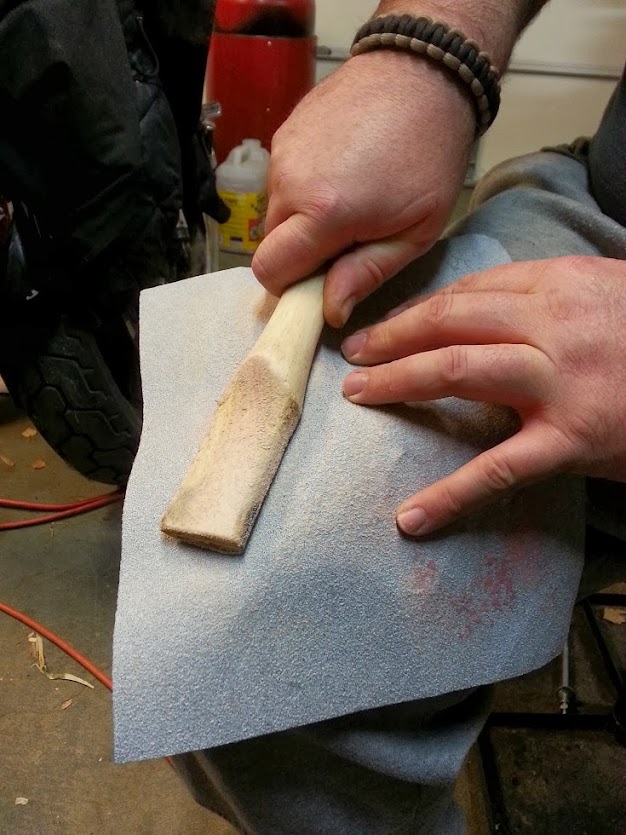
Once you get the head all cleaned up, it is time to haft it. The hardest part of hafting an axe is the sanding that needs to be done in order for the handle to fit properly in the eye.

Sanding the handle

Sanding the handle

Once it slides most of the way into the eye and actually FILLS the eye with no real gaps. You want it nice and snug, but not to the point where you are shaving the wood as it goes on.

Handle sanded to fit

Handle sanded to fit

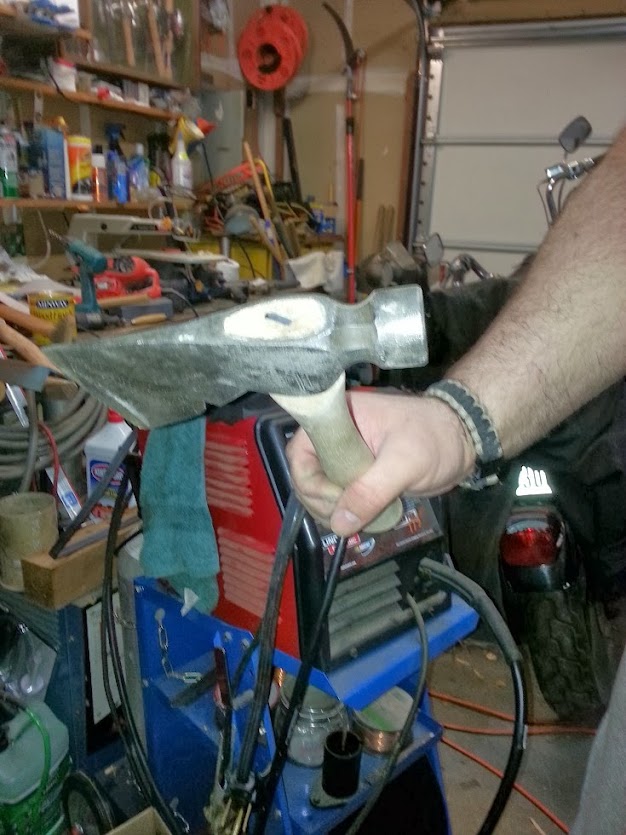
Once you get it perfect, the head should be tapped onto the handle through the use of gravity. Smack the handle straight down on the ground to let gravity drive the head onto the handle. This keeps the head from twisting and binding onto the new handle. Once it slides all the way onto the handle and will go no further, you can go ahead and put in the wood wedge. The wedge is gently driven into the slit at the top of the handle. Use of a mallet rather than a hammer keeps the wedge from breaking or splintering. Remember that the wedge should fit into the eye just like the handle. If you have to trim a little bit that is fine.

Wedge in a double bit

Wedge in a double bit

Keep driving until you have completely filled the eye of the axe with the wood from the handle and the wedge. It should bulge over the edges of the eye a bit. “Muffin top” is a good way to describe it.

Wedge driven in

Wedge driven in

When done with driving the wedge in, trim down the excess. Leave just a little bit of the “muffin top” above the top of the head. This helps keep the head fitting tightly and also gives it a classy look.
Double bit wedged and trimmed

Double bit wedged and trimmed

After all this is done, you can (if you want) put in a metal wedge to help keep the wood wedge from sliding out over time. The best way to do this is by driving the metal wedge in at a diagonal as shown in the picture below.

Handle totally done

Handle totally done

There is a lot of pride and fun that can be found in restoring old axe heads. To date, I have redone several dozen and put them back in service. Seeing an old tool that was a step above useless suddenly come to life with a little TLC can make even the most hardened woodsbum get a little twinge of emotion. Even more emotion that what a double bacon sandwich cooked over a campfire can create!

Well, happy hunting and hafting everyone. Get out there and find your Collins, True Tempers, Black Ravens, Hultsafor Bruks, Plumbs, and Norlunds. Make them awesome again. Most importantly, have some fun!!!!

  • Share on Tumblr

The Beauty of the Twig Bundle

by Woodsbum

Most people love a good campfire. The problem is that there is an art to the whole “fire building” thing. If you don’t know how to make feather or fuzz sticks, gather tinder and kindling, know the difference between green or dried wood, etc., you can be stuck using one of those fire starter logs on your next camping trip. What I am going to do is start adding a few fire starting techniques and instructions to help you along if you do want to start a fire on your next outing.

The first series of instruction is on the “twig bundle.” It is also known as the “Apache match.” All it really consists of is a gathered bundle of dried twigs that range from the width of a pencil lead to the size of a disposable pen. These puppies get very hot, very quick and burn long enough to get some bigger split wood burning. They are quite effective and I personally use this technique about 1/3 of the time I am out in the woods.

Your first step is to gather as many twigs as you can find. They should be very dry and range in size from pencil lead diameter to the diameter of a disposable pen. When gathering these twigs it is imperative that you only gather those that are very dry. To test to see if they are dry enough you should bend them and see if they snap. If they tend to bend more than snap, the twigs are not dry enough. Gather enough to be able t make a bundle about 8 inches in diameter. To judge this size you can look the length of a United States Dollar. It is about 6 inches long. Get a group of twigs together that create a bundle farther across than the length of that dollar.

Once you get your twigs gathered, break them into 12 – 16 inch chunks then separate them by diameter. The thinner pieces need to be in the middle of the bundle and the thicker pieces need to be towards the outside. This allows the thinner pieces to catch on fire and get the thicker pieces going after it gets hot enough. You pile of twigs should look like this.

Pile of twigs

Pile of twigs

After you get them sorted and built into a good, organized bundle you should find yourself some sort of cordage to tie the bundle together. Twine, inner tree bark, fresh tree branches, stalks from weeds, blackberry vines, etc., all work well. In this picture I used a fresh bough I cut off a tree that kept poking me as I worked.

Tied twig bundle

Tied twig bundle

As you can see, it doesn’t have to be perfect. All you are going to do is start it on fire, so generalized “organization” is more than perfect. As long as it is relatively “organized” you will be fine.

Once you get your bundle ready to be lit, you then need to decide how you are going to light the bundle. Some common methods include the use of cotton balls, dried cat tails, jute twine, dried grass, inner bark of a dead tree…..  The list can go on for days. The important thing to remember is as such: Get some easily combustible material to nestle into one end of the bundle and get a different pile of materials to get your actual flame. You DO NOT want to fight the twig bundle as you are trying to get an actual flame started. Get the flame and then start the bundle on fire. If you pack one end with something like dried grass, the whole end of the bundle will take off in a matter of seconds.

If you are wondering what I use, you might be a little scared. I tend to use flint and steel to get a piece of charcloth going, then blow a “nest” of dried materials into flame. Once I get that going I get the dried material I packed into the end of the bundle started, which in turn make the bundle burst into flames. I use this method because of the extremely wet environment in which I live. You might not have as many issues if you don’t live in a rain forest type environment.

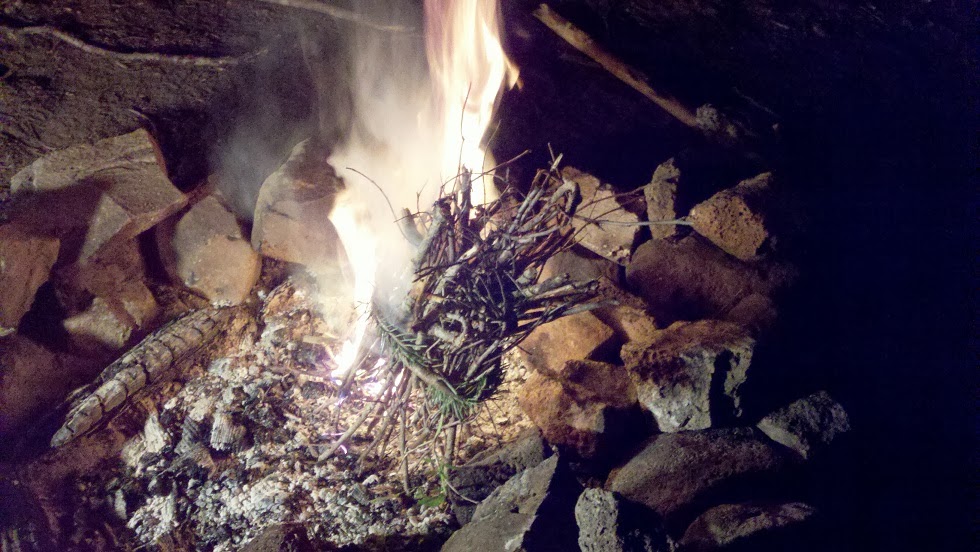
Once your twig bundle takes off, it will get hot and burn quickly. Don’t forget to have yourself some staged firewood ready in various sizes that range from the diameter of a dime to the size of a quarter to begin with. You will take your brightly burning twig bundle and use that as a way to get your other materials going.

Twig bundle burning

Twig bundle burning

These bundles burn for several minutes and get a good set of coals started. It is a great method to start working with as you progress in your fire starting skills. If you look at the next pictures, you can see how setting the bundle on end will get you a fairly high and hot fire going. This helps you get split wood burning quite effectively. Again, make sure you are using dry materials. Green wood and materials do not burn very well.

Twig bundle set ablaze

Twig bundle set ablaze

In this next picture you can see how I just added bigger twigs and branches to build a good set of coals with which I could cook. The better the bed of coals you build, the easier and better it is for cooking. It also makes it easier to keep the fire going all night long if you have a solid bed of coals going. We will get into stoking fires for a full night’s burn and the different types of fire lays in another post. Just remember that you need to have a bunch of small pieces of wood burning before you add bigger pieces. Also keep in mind that you need to step up the pieces and not drop an entire tree on a new fire without a coal bed. If you do move up in size too quickly, the fire will go out. Again, this will be touched upon in later posts.

Twig bundle with larger branches in a modified tipi style fire lay

Twig bundle with larger branches in a modified tipi style fire lay

I hope that this helped some of you that are new to building campfires. As I remember to take more pictures, I will show several more fire building methods to include the use of metal matches/firesteels and flint/steel. There will also be posts on making your own charcloth as well, so keep checking back for more fire building tips and instruction.

  • Share on Tumblr

Magpul Stock Spacer Sling Stud Install – Mossberg

by Woodsbum

I was lazy and only got out two posts for last week. I think today’s post might make up for it. GunGuy has a Mossberg 590 that he put a Magpul forgrip and stock on. The problem is that the spacers don’t have enough “meat” in the plastic to allow for installing a sling stud for hooking up a sling. That is where I was “invoked” (yes, I used the word ‘invoked’ for it is not often that someone gets the chance to use such an AWESOME word).

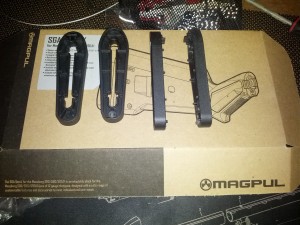
Here is the piece that I am talking about.

Magpul Stock Spacers

Magpul Stock Spacers

So after much deliberation, planning, plotting, scheming, drinking, and gazing intently into the eyes of this plastic piece I formulated a plan.

Step 1:

Mix your rum with your RC to begin the process. No project is truly kicked off until your beverage of choice is within arms reach.

Captain Morgan

The Good Captain

Mixed with:

RC

RC

Step 2:

I found the correct size bit and drilled the initial hole for the stud. Now remember that the hole you drill will end up only making a channel in the “guts” of the plastic. If you look closely, you can see how the bit goes through the top part, but the plastic isn’t solid internally. It is hollowed out to save on weight, money, costs, or because “plastic trees” are endangered. At any rate, you really have to make sure that the spacer is held firmly while you drill so that it doesn’t move sideways and mess up your hole.

Drilling hole

Drilling hole

Step 3:

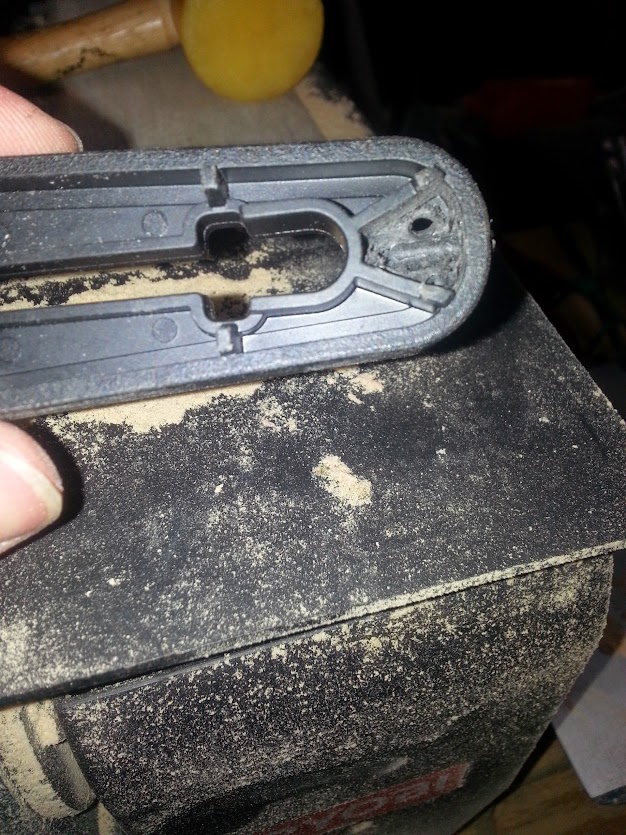
Once you get the main hole drilled, you need to drill out the channel for the screw and a couple of other holes for your epoxy to set in. This will keep your epoxy from popping out of the hole as if you were only making a casting of the inside of the spacer. Look closely and you will see a hole on both sides as well as few additional channels I carved to give the epoxy some good footing.

Channels Dremel tooled out

Channels Dremel tooled out

Step 4:

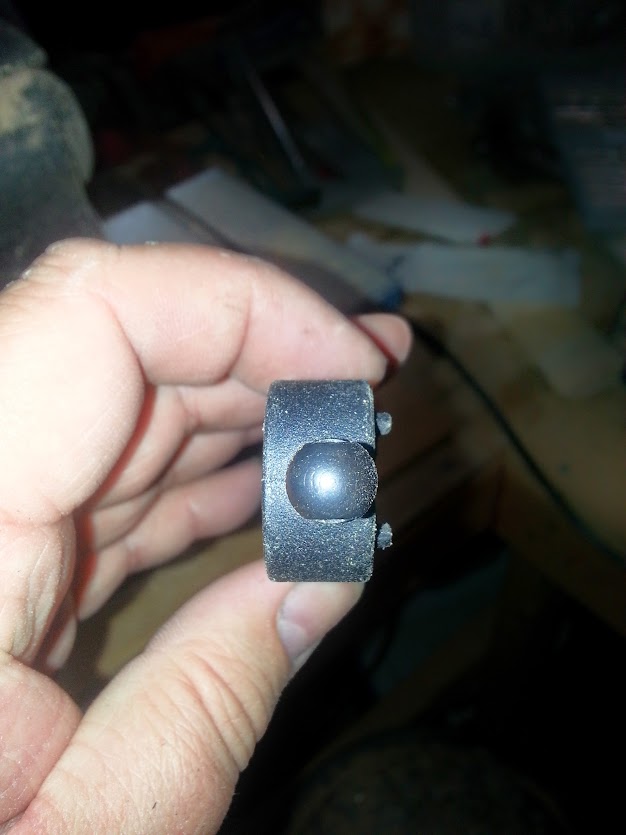
I then installed the stud so that the threads tapped the plastic piece. I also pushed down really hard on the stud’s threads that were showing as it went into the spacer so that the channel I carved with my Dremel was actually threaded as well. Here is a picture of it all lined up and ready for the next step.

Ready for epoxy

Ready for epoxy

Step 5:

At this point I plugged the holes that I had drilled so that the epoxy would not run out and drip onto my work area. I also wanted to make sure that it was well contained within those holes that I had drilled for added strength.

Holes plugged

Holes plugged

Step 6:

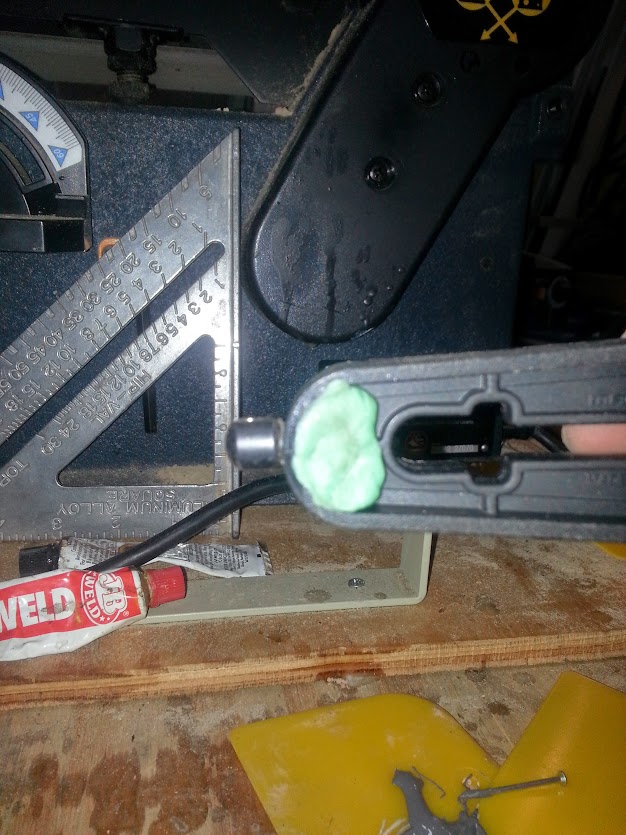
In deciding upon an epoxy for this project, I looked at several. I even tested several. For whatever scientific reason, JB Weld was the best choice. It didn’t adhere to the plastic as well as other choices, but it really stuck to the threads of all my testing materials I worked with. It came down to a compromise of metal adherence versus plastic adhesion. To help with the plastic adhesion, I drilled those holes and forced the epoxy into those holes to work as a sort of pin. My other thoughts were to drill around the screw and use tie wire to essentially redneck it into staying, then epoxy it. I was afraid that this method would compromise the integrity of the plastic spacer too much and opted to use this method instead.

Epoxy time

Epoxy time

Step 7:

I used finishing nails to force the epoxy into the holes and channels that I had carved into the plastic with a Dremel tool. After an hour, I did go in and remove the putty I used on the back side of the stud so that I could check the penetration I got with the epoxy. It filled the hole well and seemed to be setting up as expected. Here it is after an hour of drying in my garage. I told GunGuy to wait for a couple days before he installs it and tries it out, just in case the epoxy somehow was slow drying due to its age. I really think it will be fine as of tonight, but don’t tell him that.

Finished and drying

Finished and drying

The rest of this project involved a couple more glasses of Capt and RC, a horrible movie that I can’t even remember now, and some pizza from Papa Johns. Other than that, I think this project is a wrap!

  • Share on Tumblr

Condor Phantom Jacket

by Woodsbum

This is going to be more of a review than anything else. Being a bit of a gear freak, I usually have bad things to say about clothing items I buy not being <this> or not having enough <that>. Most non clothing items I get I end up falling in love with. Clothing, not so much. Every once in a while, I do run across items that I REALLY do love and endorse. Enter the Condor Phantom…….

Condor Phantom

Condor Phantom

This soft shell jacket is truly one of the best investments I have made. It is a waterproof, soft shell jacket with literally pockets everywhere. Each sleeve has a pocket. There is a slanted chest pocket. Hand warmer front pockets with a pocket inside each one of those for an iPod or something. Inside there are two pockets that are made from the two lower hand warmer pockets that fit compact pistols very well for concealed carry. The back portion of those also have pockets and a pen loop. See that I said? Pockets EVERYWHERE!!!!

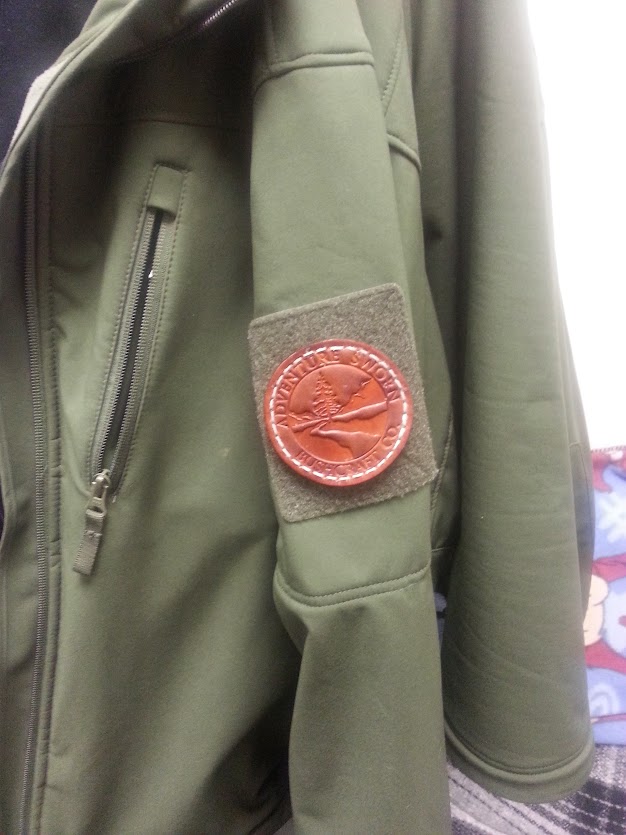
It also has Velcro on the sleeves for morale patches.

Condor Velcro and AdventureSworn patch.

Condor Velcro and AdventureSworn patch.

My first real outing with this jacket was in sub 30 degree weather with blowing snow and sleet. We took a several mile hike along a ridge to go have some bacon sandwiches with my son. Whereas he ended up getting a bit cold and wet, the only issue I had was getting a bit warm with the physical exercise. This called for me to open the arm pit ventilation zippers for the entire trip.

Snowy trip with my Condor Phantom

Snowy trip with my Condor Phantom

On another outing I wore it and even ended up taking an afternoon nap while under the cover of poncho I put up to keep the rain off me. The temperature during this outing was down into the 20s and I was not moving. Yes, the wetness on the rocks is ice and it was actually raining-ish at the time. For those in Western Washington, you know this weather quite intimately while in the mountains.

Catching a nap

Catching a nap

The reason I put these pictures up was to show you how well this jacket breaths and allows you to keep a constant body temperature in frosty temperatures even without moving. It truly is a great product.

I have had this coat for about 3 months thus far. It has been put through its paces in the mountains (3 out of 4 weekends on average), in town (daily wear), and in the heavy brush of the lower lands of Western Washington (on off weekends). It has held up without showing even the slightest wear or show of wear. It also works as my conceal carry coat where I just put my M&P Shield right inside a pocket without even a holster. There are enough pockets that I also use it to carry all my crap around rather than grabbing a rucksack about half the time.

If you are in the market for a soft shell, waterproof jacket that will keep you warm with enough pockets to make a kangaroo jealous I suggest this jacket. It is well worth the money and the look.

As another testimonial to how nice it is, GunGuy got himself one after he saw mine.

Got get yourself one!!!!

  • Share on Tumblr