
Category Archives: Emergency Preps

Anything that can be thought of as preparedness or preparedness related.

Search for a Plate Carrier/Body Armor

by Woodsbum

Due to the extra money I have from my second job, I decided that I was going to buy some things that can only be classified as SHTF, prepper, EOTWAWKI, survivalist or waste of money type items. I have have never thought of myself as a prepper. Being a strong patriarch of our family has made me put things back in case something does happen, however. Things like food, water purification, ammunition, generator, fuel, etc all have found their way into every nook and cranny of my home just in case something bad happens. If you watch Doomsday Preppers, I would never be of enough of a prepper to be allowed onto that show. Our family also isn’t living in fear of a supervolcano, impending economic doom, or an EMP attack. This being said and stated, let me add that I do believe that any responsible family should take their family’s safety seriously. If this ends up including gas masks with different filters so that you don’t have to breath in volcanic ash (since we live between 3 volcanoes – 2 of which are steaming more often than I like) or put back 6 months of food so our family won’t go hungry if any multitude of things happen (to include unemployment or hard financial times). Enough with the disclaimers……

I learned through experiencing all the tough times we lived through in Wyoming that we needed to put supplies back. We lived in Casper when the bottom fell out of the oil industry. There were times when I we were forced to shoot deer or antelope to feed ourselves. My father ended up working all sorts of odd jobs for cash and trade just to keep us from being homeless. During trips to the grocery store I distinctly remember families trying to figure out how to feed their family and mothers crying in the isles because there was not enough money to get everything that their family needed. It was horrible, but I learned a lot from both living it and from all our Mormon friends who seemed to have everything they needed. The LDS church there in Casper had all their members put back at least 1 year supply of food and daily necessities. Their ability to make it through this time when no one had money or a job really struck a nerve and made me realize the brilliance of this lifestyle.

Now let’s fast forward enough years that I will not admit to a specific number…… I have really put what I learned in Wyoming to good use. We keep all sorts of things stored up in case we need something and can’t just go to a store and buy it. As our stockpiles of “stuff” grew, I realized after watching the news that having a way to protect the bodies of my loved ones was not a bad idea. This was when I decided to just bite the proverbial bullet and buy some body armor.

Now here is the problem. This stuff almost requires that you spend a substantial amount of time just to be educated enough to buy yourself something. It is actually quite complex. Features that allow you to move the armor out of the way for medical access, rip cord things to drop the armor if it seems to be dragging you down while swimming, MOLLE vs laser cut attachments, polyethylene vs AR500 steel plates, ceramic plates, protection levels, price, color, fit, padding, whether Venus is in Scorpio during a full moon…  The list goes on and on. It is seriously crazy. To help myself and to help you readers, I am going to pass along a few things that I have learned thus far and point you toward the items I plan on purchasing next week.

First off, let’s hit up some vocabulary and nomenclature:

  • Plate Carrier – This is simply a vest that allows bullet proof materials to be inserted into pockets or under the liner to make your vest bullet proof.
  • Plates – Plates are the bullet stoppers for rifle calibers. There are various types, but just know that anything that looks like a rectangle or rectangle with the edges trimmed off the top is called a plate.
  • Shooter and Swimmer Cuts – See the definition of “Plates” above? The cut off edges allow for you to “shoot” or “swim” depending on how the cuts were made. If you didn’t cut the edges your arms would be hitting the plate and getting all messed up.
  • Soft Ballistic Panel – This is the soft version of a plate, but doesn’t stop the bigger things shot at you.
  • NIJ Level – There are several “Levels” of armor. You might even see NIJ CTP and then a number. These numbers reflect what size bullet and caliber that the ballistic material will stop. For example, you need III to stop rifle bullets. IV means it will stop some AP (armor piercing) rounds. IIIA means that it will stop almost all pistol rounds…..  Do yourself a favor and check a chart.
  • More Terms

Just those terms alone will help you enough to start looking around. Just know that a plate carrier is USUALLY not made of a ballistic material. In another words, your plate carrier needs inserts or plates to stop a bullet. Otherwise it is just a very expensive vest that isn’t very fashionable.

So the first step you need to do is decide upon “soft” or plate armor. I have not done too much research on soft armor other than lifespan. You will have to eventually replace soft armor. It only lasts for a finite amount of time due to fiber breakdown from heat and moisture. Since I want it to stop rifle calibers, this was an easy choice for me. I may get some soft armor later on for concealment reason, but at this point I am just getting something that will save my bacon if shot with an AR or AK.

The next step is to look at your bank account (and in my case cry a little) to decide how much you want to spend. The plates are going to really eat up a good chunk of your budget. AR500 plates are the cheapest and cost around $100-$200 per plate. Sometimes you can get package deals where you get front, back, and side for around $250-$300. This is on top of the plate carrier cost so a simple setup will run you around $400 as a baseline cost and can go up from there. If you go for the polyethylene plates that are much lighter and float, you can see prices around $400 for a single plate. Ceramic plates seem to be all over the place in price from $350-$500 per plate. Either way you are doubling the cost of your armor if you use anything other than the AR500 steel plates.

Lastly, look at the attachments and accessories that you can get for your system. There are all sorts of different items that can Velcro on such as ballistic shoulder/arm protection, ballistic groin protection, ballistic neck protection, shoulder straps, magazine pouches, bags, holsters, the kitchen sink….  All sorts of stuff is available for your pack animalistic pleasure. The price and strength of your legs to carry everything are the only restrictions.

Ironically, the hardest part of the whole body armor purchase has been finding a plate carrier that will be big enough for me. I suspect that most people will have similar issues finding something that fits comfortably. My problem is that I am tall and big. We are talking about someone the mid-sized professional wrestler. Most products I find are too small around the chest if they fit my waist, are too short, or are too big around my waist to fit my chest. There is little middle ground with products so sizing me is always difficult. Since we are talking about carriers that can range between $70 and $700 for those that I looked at, just to get one in for size comparison is an expensive proposition. I think I have found one that will work and isn’t too crazy in price. If it works, I will post about it when I get it. Now, I am not sure how many of you can get a chance to find a vest to check its size. I have been trying to figure that out myself. My best guess would be a LEO outlet or trade show, but I am not sure how that stuff works. I am basically checking YouTube and crossing my fingers.

So here is what I plan on buying as of next week (after this weekend’s 2nd job money comes in):

  • Condor Defender Plate Carrier
  • AR500 plates (front, back, and side)
  • Kangaroo Mag Pouch

This will run me about $400 for the set. It will also be about 25-30 lbs of weight. I guess my rear end needs to get less weight lifting time and more cardio to carry this crap. No matter what, I will show you guys what I have picked up when it comes in as well as my thoughts on it. I will not, however, go shoot it and see what happens. There are more than enough videos online that destroy these expensive plates.

Good luck people and I hope none of us actually has to use this stuff.

  • Share on Tumblr

Bridgford Ready To Eat Sandwiches

by Woodsbum

Today’s post is near and dear to my heart. It is about food. I love food and love food that is able to be stored for long periods of time, be easily transported, takes no real preparation before consuming, and ACTUALLY TASTES GOOD. Enter the Bridgford Read to Eat Sandwich.

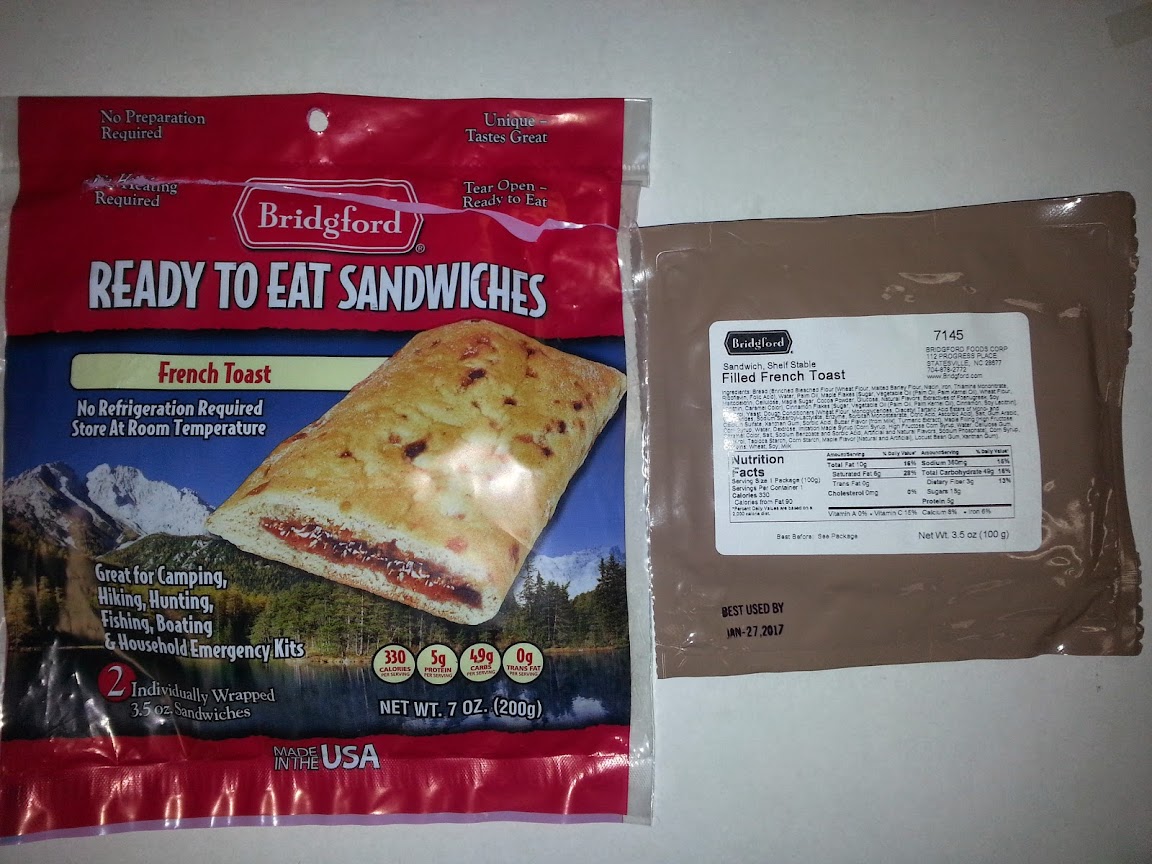
This sandwich package was about $6 for two wrapped breakfast creations. There are tons of different varieties, but this was what we tried first. I figured that anyone who could make a French toast sandwich in a shelf stable form that tasted decent was on to something. Now I have eaten MORE than my fair share of MRE’s while in the military. Many were barely edible, but some were pretty good. The most current batches are actually downright tasty. If Bridgford is able to tap into any of that tastiness for their product, these things might be a winner…..  Now for the opening and testing.

This is how the sandwiches are packaged. Two of these tan wrapped sandwiches come in each plastic bag.

Bridgford Sandwiches

Bridgford Sandwiches

The foil wrappers are just like MRE wrappers and open exactly the same. As a nice change, however, there is nutrition information on the side if each sandwich. It also makes it nice to be able to figure out exactly what you are eating. Makes me wonder what the “4 Fingers of Death” (Beef Frankfurters) MRE really had in it….  Hmmmmm……

Nutrition Information

Nutrition Information

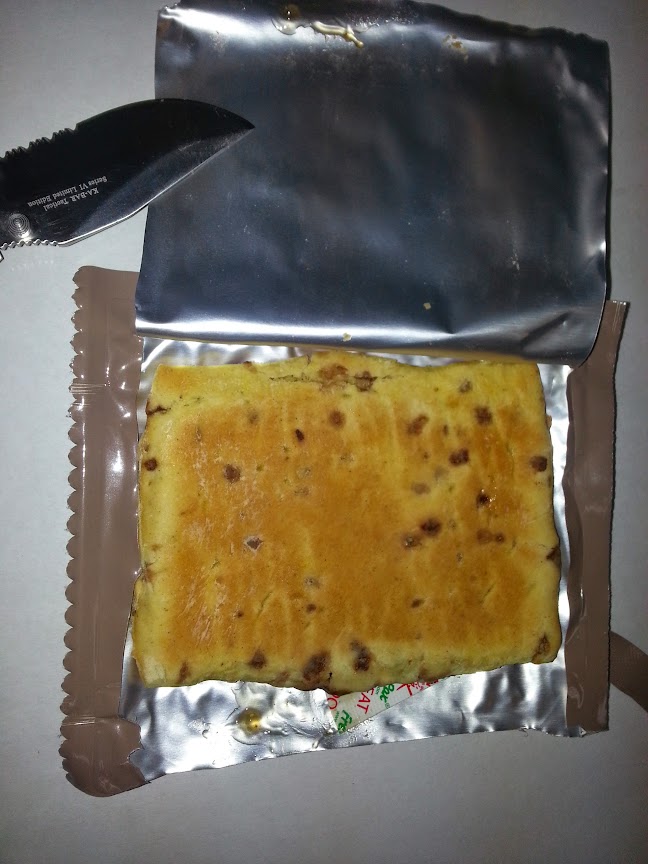
The actual sandwich look very reminiscent of the old MRE maple nut cakes. It also had that same smell, which definitely brought back memories. Here is what the look like with the wrapper pulled back.

Unwrapped

Unwrapped

The taste was also very similar to the MRE maple nut cakes, but a bit more sweet due to the syrup. All in all, they were not that horrible. As a primary source of food on a daily basis you could not run fast enough to get me to eat one every morning. As an occasional meal while out in the woods or in a SHTF type situation, you bet I will be back in line for seconds. On my “Tastiness Scale” I would give it about a 6/10. As a matter of reference I consider my tuna casserole 1/10 and my prime rib a 10/10. This fits in around the BBQ chicken area of the chart.

I am actually looking forward to trying out several more variations of these sandwiches. If they can make the French toast into a shelf stable variant that tastes this good, their Italian and BBQ versions must be incredible.

  • Share on Tumblr

FCC/FEMA Tips for Communicating During an Emergency

by Gunguy

Civil Unrest / Natural Disaster Home Preps link here.

Preparing for an emergency:

  1. Know what type of landline telephone service you have. Some newer forms of telephone service will not work without electric power. Understand whether you have this newer type of service, such as Voice over IP (VoIP), which is provided over broadband connections, or more traditional telephone service, which typically is powered over copper telephone lines. Ask your service provider if you are unsure.
    • If you have newer telephone service that works with battery backup equipment during power outages,test the battery periodically, understand how long it should last, learn how to replace it, and consider having a spare battery that you can charge before a storm. If you do not have battery backup equipment, ask your provider if they can supply it or if it is available elsewhere.
      • If your electricity goes out and you don’t need to use the phone right away, you can disconnect the battery to prevent it from draining and plug it back in when you need to receive or make calls.  Once power is restored, plug the battery back in so it can recharge.
    •  If you have traditional telephone service, it may work during electric power outages – but you may need to use a “corded” phone. Remember that many cordless home phones rely on electric power to operate.
  2. Charge your wireless phone if a storm is coming. Also consider keeping an extra battery and a car charger on hand.
  3. Charge your laptop or tablet computer if a storm is coming. If your electricity goes out but secure WiFi is available in your community, you may be able to use your computer or tablet to go online and send emails. You may also be able to use the battery power in these devices to recharge your wireless phone using a USB cable, but be careful not to drain the battery power of your computer or tablet if you need to go online.
  4. Broadcasters are an important source of news during emergencies, so consider keeping a battery-operated, solar-powered, or hand-crank-operated radio or digital portable television for use during power outages. Make sure you have charged or fresh batteries if needed. Some hand-cranked radios can also be used to charge cell phones, but check the instruction manual before assuming this is the case. 

    During an emergency:

  5. Limit non-emergency phone calls. This will minimize network congestion, free up “space” on the network for emergency communications, and conserve battery power if you are using a wireless phone. If you do need to make a call, try to keep it brief and only convey vital information to emergency personnel and/or family.
  6. For non-emergencies, try text messaging from your wireless phone.  In many cases, text messages to other wireless devices will go through when your call may not, though there may be a delivery delay during times of network congestion.  (In most locations you cannot send a text message to 911, however.)
  7. Adjust your wireless phone. Check your wireless device or manual for ways to conserve battery power, such as dimming the brightness of your display screen and disabling certain applications.  If you have difficulty accessing your wireless network, consider connecting to WiFi service if your phone is WiFi-capable.  If the wireless network in your area is damaged and you do not see any signal bars on your phone, consider turning your phone off to prevent the battery from draining as your phone seeks a usable wireless signal.
  8. Call 911 only for emergencies. Learn and use the designated number in your state for highway accidents or other non-life-threatening incidents.
  9. Wait 10 seconds before redialing a call. Redialing a wireless call multiple times in quick succession can increase network congestion, further limiting the ability of all users to place calls.  If you must make a call, space out your call attempts.
  10. If you have call forwarding on a landline phone at home, consider forwarding those calls to your wireless number, particularly in the event of an evacuation, so that you can continue to receive incoming calls to your home telephone number; and
  11. If you do not have electric power in your home and are using your car to charge wireless phones or listen to news on the car radio, be careful. Don’t try to reach your car if it is not safe to do so, and remain vigilant about carbon monoxide emissions from your car, especially if it is in a closed space.

Find more information at www.ready.gov, http://www.redcross.org, or www.fema.gov.

  • Share on Tumblr

Civil Unrest / Natural Disaster Home Preps

by Gunguy

So all this civil unrest has finally made some people I know really want to get involved
with prepping. They have asked me how they should start out and what to keep in mind. In order to not overwhelm them I suggest the following as a minimum to keep in their homes. I recommend enough supplies to last them at least a week.

  1. Water – I store 3 gallons per person per day. Useful fact: Each 24 count case of 16.9 oz water bottles equals 3.16 Gallons.
  2. Food – Store what you normally eat and possibly some Mountain House freeze dried food for convenience. Make sure you try it before the emergency occurs to see if you like it.
  3. Portable gas stove to prep food and boil water. Get extra fuel. Open the window when cooking for air flow.
  4. Portable Toilet – 5 gallon bucket with seat lid. Toilet paper, baby Wipes, 13 Gallon trash bags for waste and any feminine products go inside the bucket when being stored.
  5. Big hand sanitizer to disinfect hands and save on water.
  6. Emergency AM/FM/NOAA Weather Radio. Hand crank and solar powered radio.
  7. Headlamp flashlights and extra AAA batteries.
  8. Emergency lantern and DD batteries.
  9. External battery pack to keep phones/ipad charged for several days without power.
  10. Security Door brace to reinforce your door(s).
  11. Cash – small bills.
  12. Safety – Whatever weapons or harsh words you can legally use to defend yourself.
  • Share on Tumblr