

by Woodsbum
In the spirit of both the Christmas season and our “back in the day” philosophy here at AOD, I thought I would do today’s post on this little known holiday character. I say that he is little known because I am a bit of a trivia buff, but never heard of him until I saw someone dressed up as Krampus that showed up to the bar during a Santacon. His costume was really incredible and even though he was a regular at the bar I barely recognized him. This got me to wondering: How did I miss this whole Krampus thing and who the heck is he?
When I got to work the following week, I asked one of my coworkers about Krampus. He knew exactly who this guy was and his history. Again, how could this be that I had never heard of him? Come to find out I was also in the dark about this whole “Santacon” thing as well and he knew all about that. I guess I was REALLY uneducated about the whole holiday festivities thing so now I felt the need to do some research.
I got a lot of information from the Krampus.com website and here is some history of the guy:
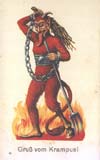 Krampus is the dark companion of St. Nicholas, the traditional European winter gift-bringer who rewards good children each year on December 6. The kindly old Saint leaves the task of punishing bad children to a hell-bound counterpart known by many names across the continent — Knecht Ruprecht, Certa, Perchten, Black Peter, Schmutzli, Pelznickel, Klaubauf, and Krampus. Usually seen as a classic devil with horns, cloven hooves and monstrous tongue, but can also be spotted as a sinister gentleman dressed in black, or a hairy man-beast. Krampus punishes the naughty children, swatting them with switches and rusty chains before dragging them, in baskets, to a fiery place below.
Krampusnacht (Night of Krampus)
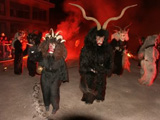 Krampus is celebrated on Krampusnacht, which takes place on the eve of St. Nicholas’ Day. In Austria, Northern Italy and other parts of Europe, party-goers masquerade as devils, wild-men, and witches to participate in Krampuslauf (Krampus Run). Intoxicated and bearing torches, costumed devils caper and carouse through the streets terrifying child and adult alike. Krampusnacht is increasingly being celebrated in other parts of Europe such as Finland and France, as well as in many American cities.
Krampus’s Ancient Origins
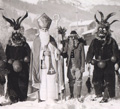 The European practice of mummery during the winter solstice season can be traced back tens of thousands of years. Villagers across the continent dress up as animals, wild-men and mythic figures to parade and perform humorous plays. This ancient guising and masking tradition continues to this day as the primary source for our modern Halloween with its costumes, trick-or-treat, and pagan symbolism. Among the most common figures in these folk rituals were Old Man Winter and the horned Goat-Man — archetypes now found in the forms of Saint Nick/Santa Claus, and the Devil (‘Old Nick’), aka Krampus.
Santa the Punisher?
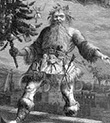 In 19th century New York City an American St. Nick emerged in the form of Santa Claus. Although based on the Dutch Saint Nicholas, Santa incorporated more elements from pagan winter solstice customs. He relinquished his white bishop garb for a red suit, traded his horse and staff for a sleigh and reindeer, and moved his franchise to Christmas Eve.
 Santa also tried to take over the dark companion’s job of punishing the naughty, but his New World temperament was apparently unsuited for the task. As Santa neglected and abandoned his punishing duties, American kids lost all fear of Santa and his lumps of coal. Thankfully, in the 21st century, Krampus has arrived in this land of spoiled and dissatisfied children to pick up the slack.
Krampus Cards
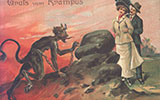 While Santa Claus expanded shop and sold products in mid-1800s America, the holiday card craze exploded in Europe.
 In Austria and other parts of Europe, countless season’s greeting cards featured Krampus, often emblazoned with the phrase “Grüß Vom Krampus” (Greetings from Krampus). While the lurid images are suffused with a modern sense of the comic and the surreal, they still resonant with mythic power and primordial horror.
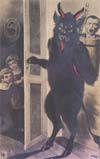 And with Krampus representing the naughty side of the season, the sexy subtext is hard to ignore in these often very cheeky cards. A century later, the brilliance of these magnificent works of pop art is now gaining global recognition.
Krampus in America


A New Spirit of Xmas?


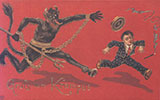 A new appreciation of ancient traditions that smoulder in the dark recesses of holiday revelry continues to rise around the world. Krampus, with his horns, hoove and tongue, embodies this revived spirit of the Xmas season!
Krampus Through the Ages
- 2000 BCE Enkidu appears in the Epic of Gilgamesh, the earliest known appearance of a ‘Wild Man’ in literature.
- 600 BCE In the book of Daniel in the Old Testament, King Nebuchadnezzar is punished by God for his pride when he is turned into a hairy beast.
- 217 BCE Saturnalia is introduced as a winter celebration in Rome, marked by gift giving, wild parties, and a reversal of the normal social roles of slave and master.
- 4th Century CEDue to Roman influence, many Germanic tribes, such as the Goths and Vandals, convert to Christianity; their pagan traditions survive in small villages in the Alps where the Church cannot penetrate.
- 1250 CE King’s Mirror, a Norwegian text, features a Wild Man character who is described as being covered in hair.
- 17th Century CE ‘Knecht Rupert’ appears as a figure in a Nuremberg Christmas procession.
- 1810 CE The Brothers Grimm began publishing stories of Germanic folktales, marking a resurgence in Germanic pagan folklore.
- Early 19th Century CE Holiday postcards from Austria, Germany, and other parts of Europe feature holiday greetings Krampus and other companions of St. Nicholas.
- Early 19th Century CE Germanic and Dutch immigrants to the US popularize ‘Pelznickel’ traditions in Pennsylvania, Maryland, and as far west as Indiana.
- 2004 CE Blab! Magazine curator Monte Beauchamp publishes Devil In Design, a collection of vintage Krampus postcards from the turn of the 19th century. This book marks an increase in Krampus’ popularity in the English speaking world.
- 2004 CE An Adult Swim show The Venture Brothers features Krampus during a Christmas special.
- 2007 CE The American television show Supernatural features an evil Krampus character.
- 2009 CE American satirist Stephen Colbert is visited by Krampus on his television show The Colbert Report.
- 2013 CE Krampus comes to the popular American television show Grimm.
- 2013 CE Krampus featured on the popular animated television show American Dad.
******************************************************************************
After seeing this timeline, I realized why I had never heard of this guy. It wasn’t really until 2004 that he reemerged into popular culture and I don’t watch or read anything on this list. I do find it interesting that Americans have suddenly started looking back to older traditions and history as of late, not for educational purposes, but as a way to inject new blood into our entertainment. TV shows and movies based in history, documentaries, and reality shows based upon primitive needs are all now the rage. I guess that dusting off an old Christmas devil would just fall right in line with this trend.
It does make me wonder what other little tidbits of interesting historical tradition that I have been missing out on. Maybe I could discover something fun like the Arbor Day Oak Tree Explosion were we use 100 lbs of gun powder to turn a large tree into toothpicks at the stroke of noon so we get another day off work? How about the Groundhog Day Puma Stalk where everyone dresses up like a mountain lion, goes from bar to bar eating wild game and drinking large amounts of whiskey? That sounds like a good one. Ohh… It would be AWESOME if there was some traditional festival based around a parade where all the floats carried beer on tap and passed out shots of Apple Pie Moonshine to all the spectators!!! Yeah!!!
Time to hit the Google!!!!
