Category Archives: Firearms

These are our BOOM STICKS!!!!

Sights

by Woodsbum

Over the years I have shot firearms with many people at ranges or out in the woods just plinking. Many times I find that the person I am shooting with can barely hit a target let alone shoot a decent grouping on the target. It seems that they don’t focus on their front sight post and are more looking through their sights. I ran across this video linked on a forum and thought that it might help a few people with their accuracy. It is all based upon focusing on your front sight post.

This first video covers the basics of what sights are and the mechanics. Even though this video is based upon airgun sights, it is good information and I like the music in the background. It reminds me of old “hillybilly” TV shows that I watched as a kid.

This is the video for those that already have the fundamentals. This is a great video.

  • Share on Tumblr

Inova Flashlight

by Woodsbum

Flashlights seem to be a big discussion item whenever you get in a group of guys talking about firearms. There are the old school Maglight guys, the headlamp hunter types and the tactical flashlight lovers. Personally, I don’t care what light I use as long as it lasts for quite a while and is very bright. By “lasts for quite a while” I refer to the lights ability to take abuse and still keep working. My friends know how I am and one of them passed along one of the lights that they use all the time. This is how I ended up finding Inova lights.

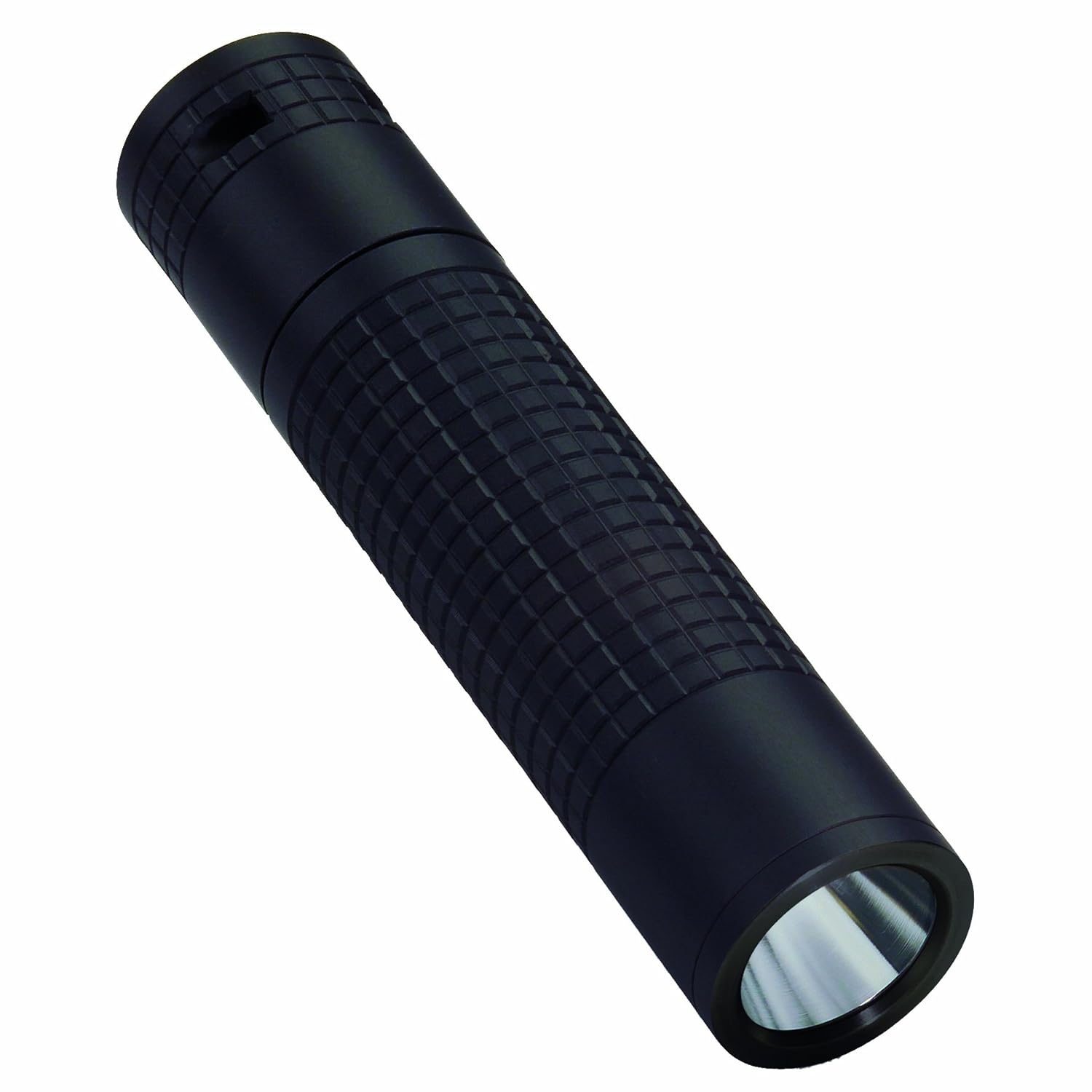
The Inova I carry is their T1TMB-HB T1 model. To make it easier for you to find or see what I am using I linked the model to Amazon for you.

This is a single LED light, but is 211 lumens on high output. It also has a low output of 20 lumens, which is about the same as a Mini-Maglight. It also has a strobe feature. All these options are accessed by pushing the button in rapid secession depending on which option you want.

I now have 2 of these flashlights, both of which I use as my “tactical” flashlight options. One is mounted to a QD rail attachment for putting on either my shotgun or rifle. The other I have next to my bed along with my 1911. Interestingly enough, they seem to be VERY tough. Mine have been all but drowned in rivers/streams, dropped off rocks, withstands the forces of both shotgun and rifle recoil, and even was run over by my truck which I really don’t want to talk about.

If you are looking for a higher quality flashlight without spending all the money on either a SureFire or 5.11, then this might be an option for you. They have models between $20 (I have one of those as well that didn’t die until I attached it to my 12 gauge and it stuck out past the barrel too far) to prices well over $100. I recommend the one I got for around $50.

  • Share on Tumblr

Custom Pistol Grips

by Woodsbum

Finding a nice set of pistol grips that fit my personality was not an easy task. That is when I started looking for actual custom pistol grips that I could send in my design to have scrimshawed on. Several companies that I spoke with would only do their designs or promised “custom” work that had to be sent off to another company to complete.

Finally I found one company that would actually do what I wanted without trying to make me pick one of their stock designs. Boone Trading Company actually specializes in ivory, bone, simulated ivory, scrimshaw, and various other animal products. When I contacted them back in the middle of February I picked out some simulated ivory grips for my Smith and Wesson Model 10-1 and sent them some graphics to have scrimshawed. They originally promised me a final product in about 3 weeks. This would get me my grips by the beginning of March. The grips never came so i contacted them again and they told me that they had gotten behind, but the were going to expedite my order. This was in the middle of March. My order arrived at my door on May 1st. It ended up being around 11 weeks from order to delivery.

At first I was kind of irritated at the prolonged and stretched out fulfillment of my order. Although I do a lot of business with custom makers, I do expect that my orders will be completed within a few weeks of their initial time estimates. Waiting an additional month is not uncommon, albeit a bit annoying. This is just the nature of the business when ordering custom work. An additional 8 weeks is a bit excessive however.

Even though it took a long time, I am really happy with the final product. The quality of the grips and the actual scrimshaw work is quite good. I am a bit of a perfectionist when it comes to custom work and expect to receive every dollar’s worth when I pay for things. For example, I have one hand forged custom knife that I paid over $500 for and then sank another $200 in a sheath. The money I paid was definitely worth the products I received. I feel the same about these grips. They were almost as much as I paid for the actual pistol itself, but they really make the firearm mine.

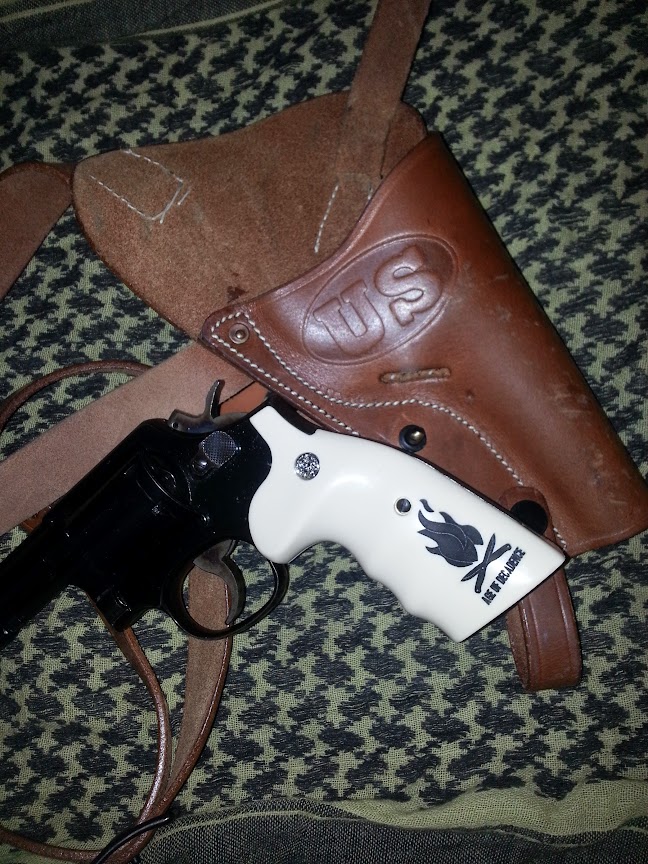
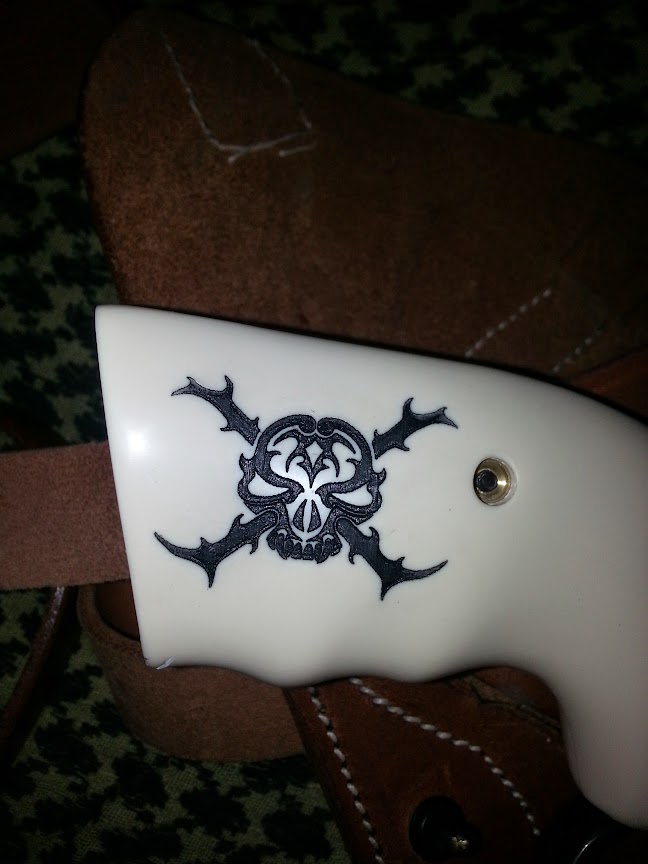
Here are some shots of the new grips on the pistol. The artwork you see here was a piece that I had an artist do for me several years ago. This will eventually be (and fairly soon) my newest tattoo across my back. I am quite partial to skull and crossbones type art, which you can see in both these pieces of scrimshaw.

Custom scrimshaw on pistol grips

Custom scrimshaw on pistol grips

The holster you see is an old military M3 chest rig. I did add an additional pieces of leather to lengthen the strap. I wanted it to ride a bit lower on my side as more of a Baldric type rig. Here is a good picture of the other side of the pistol.

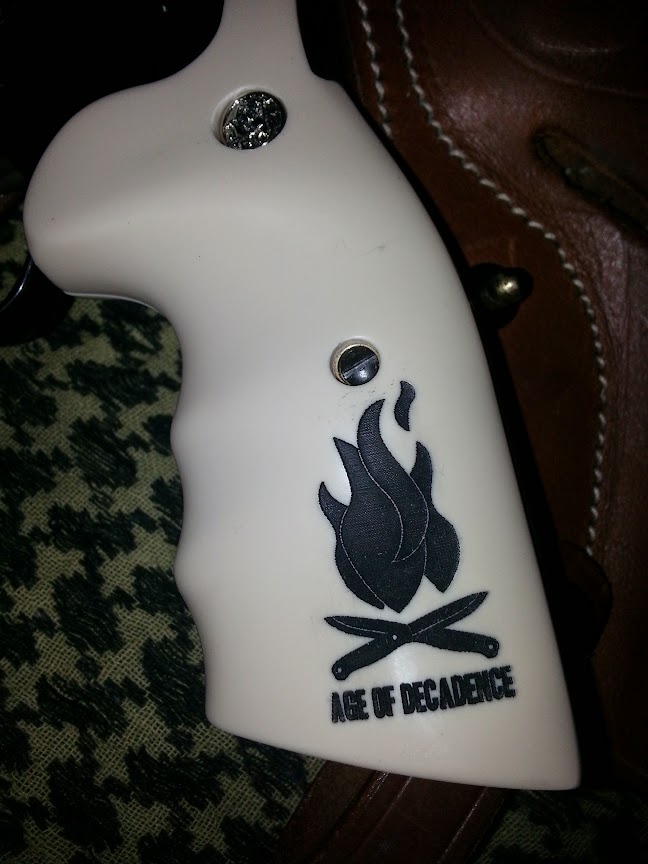
AOD logo on my pistol grips

AOD logo on my pistol grips

Both of the pieces of artwork came out quite nicely and look really impressive against the dark blue color of the pistol frame. I was impressed with the quality of the scrimshaw work. I do not think that it will discolor or chip very easily.

Close up of my AOD logo

Close up of my AOD logo

Here is a close up of the other side. As you can see, they did do a very good job on them.
Close up of the other side

Close up of the other side

As with any custom work, you need to keep in mind that the one doing the work is usually an artist. Their freedom to work at their own pace is directly representative of how nice of a final product you will receive. Don’t give up on a company or a maker just because they did not meet you proposed deadlines. Let them do their job and they will get you what you want eventually. Also, remember that you will get what you pay for. Custom work doesn’t come cheap.

In evaluating this company and the work that they produced for me, I would definitely buy from them again. I have already started thinking about some other projects, actually.

  • Share on Tumblr

Painting an AR – Part 2

by Woodsbum

This is the second part of my AR painting experiment. If you did not see the first part, you can check it out here.

Painting and AR – Part 2 is about the actual painting process as well as what I learned while actually painting on the camo pattern. This was actually harder than I had anticipated or realized it would be.

As a stencil, I used these that I found on Amazon. They are designed for airbrushing and the pattern actually looked really good when painted. I did find a could things out regarding these stencils, however. When painting with them it is necessary to block off other parts of the stencil that you are not using. For instance, if you want the middle cutout you have to block off all the other cutouts on the stencil. This was a bit of a chore to deal with due to the paper “bib” I made to protect from over spray made the stencil a bit bulky. It also caused all sorts of build up of paint in and around the actual stencil. By the time I was done with each cutout I was almost scraping off the additional layers of paint so I didn’t smear or drip in unwanted areas.

I did realize quite quickly that the easiest way to fix you mess ups was to fit a portion of the stencil over the messed up area and just paint over the spot needing touch up. It is not necessary to actually match up the stencil to the exact shape you just painted. The new lines just add additional shape to the colored camo splotch. While painting, I found this to be an all out lifesaver when I messed up.

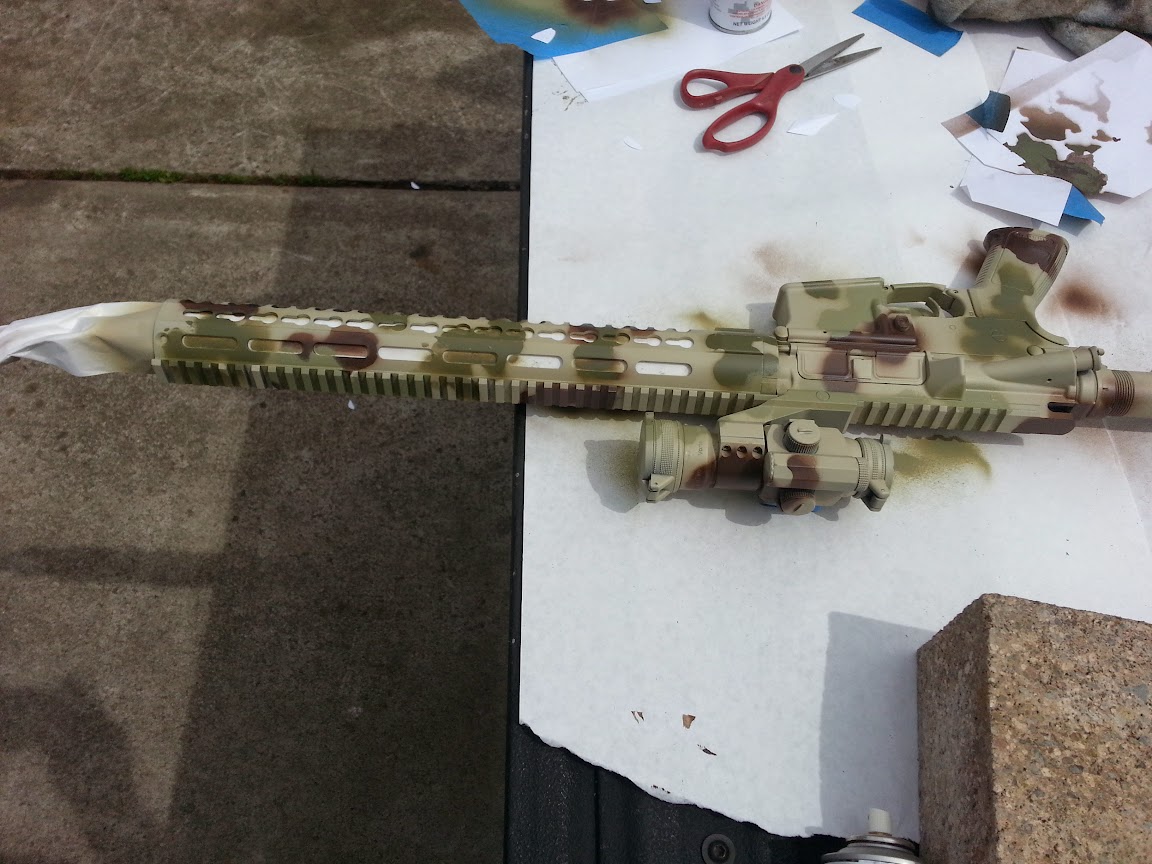
Here is a quick couple of pictures of both my progress and the layout of my painting area.

Painting area and progress

Painting area and progress

I painted on the back of my truck and used some butcher paper as the protector from over spray. At the top you can see a section of my stencil and how I covered up all the unused sections. The next picture will show a bit more.

More of my working area

More of my working area

Notice how I used masking tape and printer paper to cover the unwanted stencil designs? This helped a lot because most of the extra paint came off with the tape. I only had to scrape a little off the edges when swapping stencil shapes.

As you can see I also covered up the rubber control section of my Vortex Strikefire 2. I did this so that I would not have a lot of paint chipping off the rubber or getting on everything after it dried. Paint on rubber just seems to take forever to dry. You can also see the paper that I inserted between the handguard and the barrel. This will give it a really nice look when done.

Masking job

Masking job

When painting, I found that I put the stencil as close to the rifle as possible and did short little bursts with the spray can. This did increase the potential for runs and curtains in the paint, but it drastically reduced the amount of over spray that I had to deal with. The lines were much tighter and more defined using this method. I also found that using the tan as the base coat really lightened the overall camo pattern. If I had used a light green and then painted the other splotches on, the overall affect would have been a much darker camo pattern. I think this will work quite well as a pattern to span most environments. If I need to add a little burlap to darken it as needed, this will give me the most range in environments.

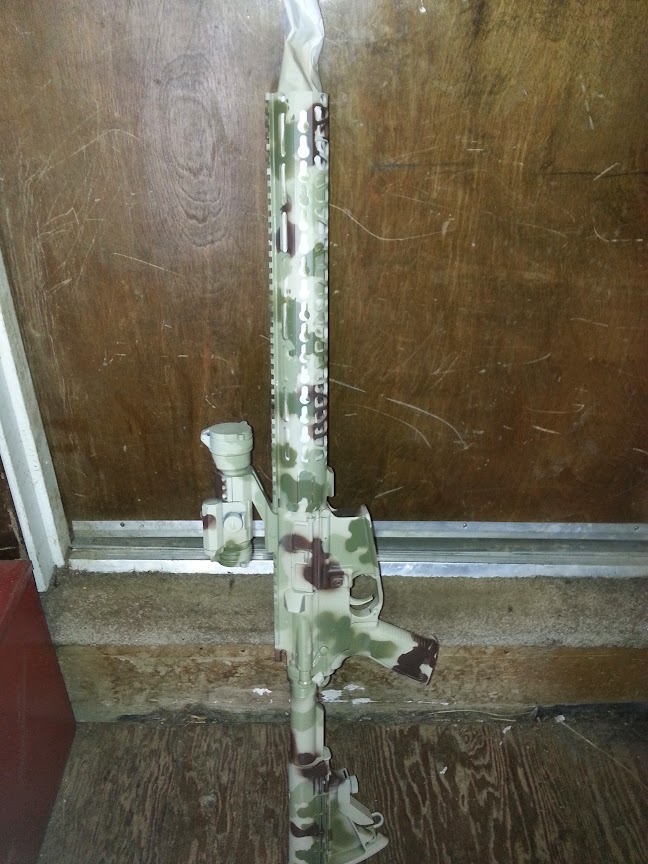
Here is the final pattern from the right side of the rifle. I took this picture before I unmasked everything so that you can see the difference that the dark barrel makes with the pattern. I would also like to point out that I just painted over the dust cover (closed) to help keep a nice pattern. When the dust cover is open, there is a black hole that blends right in. We used to keep the dust cover closed while in the field to lessen the amount of cleaning we had to do, so this is how it will be most of the time that I carry it.

Finished, but still masked

Finished, but still masked

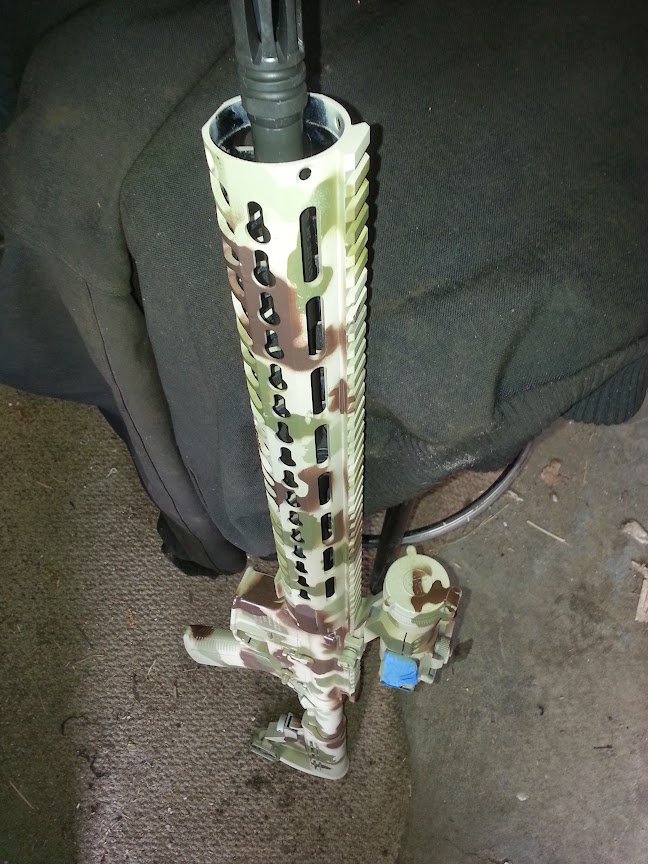
Barrel unmasked and pattern from front. The additional splotch on the front of the flip up cover helped a lot to break up the front of the rifle. Also, you can see how keeping the barrel black really helped with the camo pattern as well. It gives it a bit more depth.

View from top

View from top

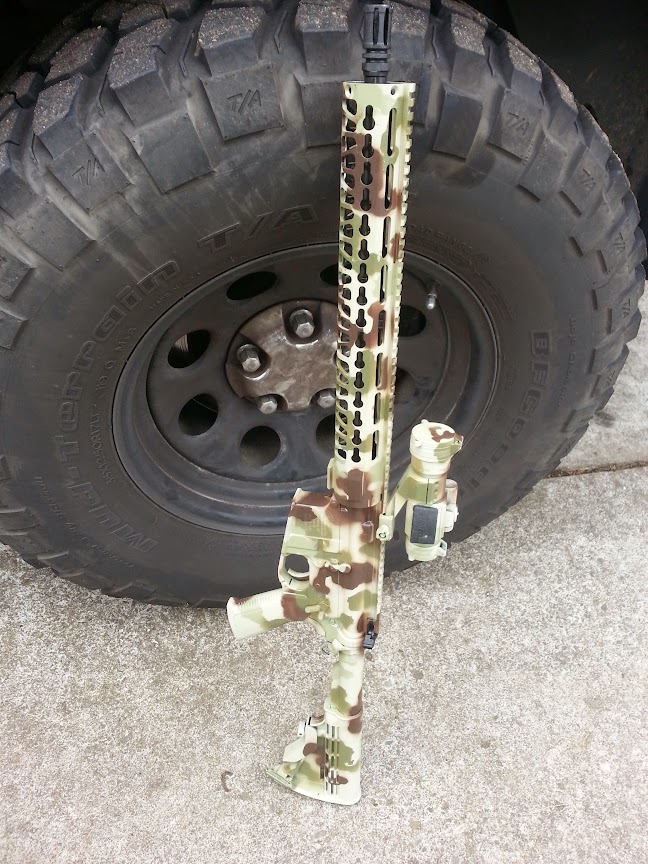
So you can see how well the black, rubber controls on the optic blend into the pattern and how the black barrel showing through the handguards also helps, I took a picture next to my truck. As you can see, the tire and rim actually show through the handguard. This will also help with the camo pattern.

Finished camo

Finished camo

The final picture I have for you is where I just tossed in onto a shrub in my front yard. Although it sticks out a bit, I think it will span quite a few types of terrain. Adding some burlap will definitely help in more green and forested type areas, but this will definitely be better for drier areas than a dark green or black rifle. The black blob effect is very visible from a distance.

Tossed in a bush

Tossed in a bush

I still have another AR to paint once the rest of my parts arrive. I will be doing it a bit different than this one just to see how the light green base works versus the tan base. It is also my SPR type rifle, so the larger silhouette will definitely need more middle of the road type base color to keep from either glowing or blobbing respectively.

  • Share on Tumblr

Painting an AR – Part 1

by Woodsbum

Recently I was the recipient of all sorts of garage dwelling goodies such wood stain, spray paint, and a rifle painting kit. To ensure that this rifle painting kit did not go to waste or possibly go “stale” I promptly started getting read for a home camo paint job.

What I have done is broken down the process into two parts. The first part will be based around the materials needed, color schemes and the base color I used for my paint job. The second part will be the actual painting process and what it all looked like after I was done. You can find part 2 here.

To precursor this whole project I wanted to establish the basis for my decision to paint my new AR. The reality of the situation is that I am more of a traditionalist when it comes to firearms. It wasn’t until recently that I got into modifying or upgrading any firearms that I own. Even more surprising is that until recently I really wasn’t too into tactical firearms or gear at all. Most of my holsters are leather and most of my backpacks are canvas. Although I have a lot of gear from my time on Active Duty, I really have never been one of those “tactical” guys that owned any high speed gear that you see the “tactical” guys running around wearing. An old LBV (Load Bearing Vest) was actually the most “tactical” thing I owned until recently so camouflaging a rifle to keep it from standing out is truly uncharted territory for me. Thanks to Gunguy for getting me more into this whole world. I thank you, but my bank account and wife probably do not…..  Just saying……

Back to the project…..  Here are the materials that are needed to complete the paint job:

  • A rifle to paint
  • Paint. I feel you should get an actual paint kit that is made to adhere to firearm coatings. The one I received was from LBX Tactical.
  • Masking tape. The stuff I got was from Home Depot, but I linked to some that is very similar to what I used.
  • Stencils. You can use vegetation or homemade cutouts, but I opted to get something a bit nicer. The paint kit from LBX Tactical actually comes with stencils, but they are a digital pattern. All my gear is Multicam. This presents a problem because I don’t want to have color clashing or pattern explosion issues…..  The fashion police might come arrest me because EVERYONE knows that being fashionable while tactical is a definite must!
  • Heat gun to dry your paint.
  • Wire or something to hang your rifle from during painting and drying.
  • Beer
  • Break parts cleaner or something to prep your rifle.
  • Paper of some sort to assist with masking and preventing over spray.

Once you get your materials all consolidated and ready for use, the first step is to drink a beer while you clean the surface of the rifle you are going to paint. I used brake parts cleaner to get rid of the oil and residue that might have been present. Once the brake parts cleaner dried, I wiped the rifle down with a rag to remove any droplets or residue. While it all dried, I finished my beer.

The next step is to get another beer and start masking off your rifle to apply the base coat. I removed the optics from mine so I could get a good coat of paint on the entire upper. I also removed the stock so I could paint the entire buffer tube. The parts that I masked off were:

  • Barrel. The barrel gets hot and I didn’t want the paint to end up bubbling or burning off after use. I also like the look of the black barrel sticking out below the keymod rail.
  • Charging Handle/Bolt Carrier. I actually removed the BCM charging handle and just taped off the bolt carrier. This way I could paint the back part of the upper with ease as well as keep the nice charging handle looking nice. It gives a nice contrast to the rest of the rifle, in my opinion.
  • The controls for the optics.

Once this was all taped off and ready for paint, I did a light and quick first coat of paint. When painting, many people have a tendency to get an overly thick coat on their first pass. This actually is a bad thing because it causes too thick of a layer that has not cured or bonded to the surface properly. Complications such as eventual chipping, runs or curtain potential is all increased due to a thicker coat applied in a single pass. It also helps to keep a beer handy while doing all this.

After several coats of paint, the entire base coat was finished. I also used the drying time between coats as a beer drinking opportunity. This is also vitally important to the project so that you get ample time to relax and enjoy this project.

Once I had completely painted the rifle I hung it up on a wire and used a heat gun to ensure the paint was not only dry, but bonded properly to the rifle’s surface. After inspection I did realize that I needed to repaint some areas, such as the area of the lower that lies beneath the safety. At first I had forgotten to move the selector to “Fire” and paint where the lever masked the lower. I also had to touch up a couple spots around the sling swivels and single point attachment.

Again, don’t forget to apply heat to the rifle after you paint it. Think of this process no different that what is done to a car after painting. It is put in a warm garage to almost “bake” the paint onto the metal. The same concept works here. The paint must truly heat up to adhere to the rifle properly.

Here is what the rifle looks like with the base coat applied.
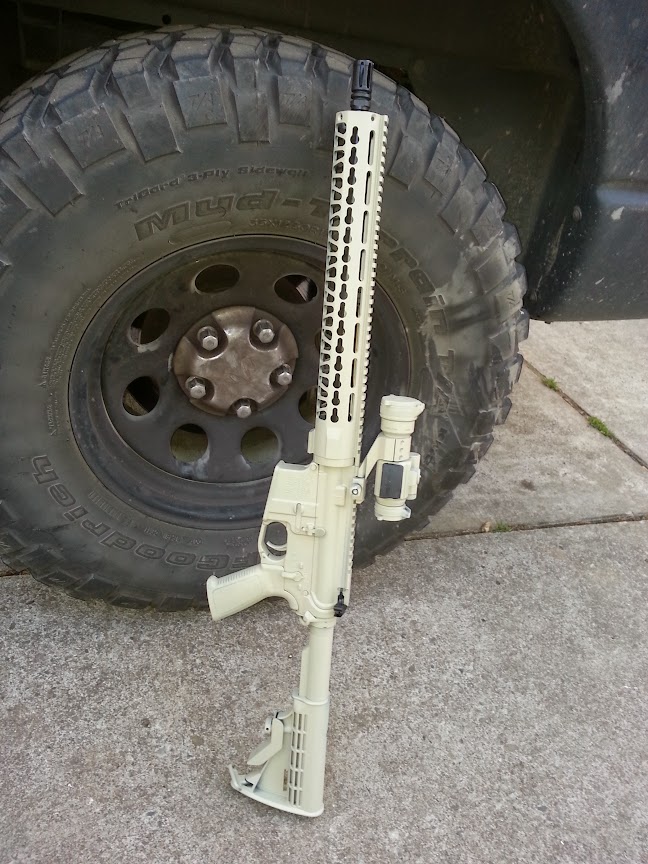
AR with base coat

AR with base coat

As you can see, the black barrel beneath the keymod rail looks kind of nice. Add the still black charging handle and it really gives it a bit of class to the job.

Here is the rifle from a little different angle. Notice how well the color blends into the rifle. This paint did a wonder job of adhering to the rifle to make a solid base for the camo pattern. I was quite impressed with the paint in the kit. The real “hero” here, in my opinion, is the heat gun that I used between coats. I could see the texture of the paint change to really match the texture of the receiver and hand guard when heat was applied. It evened out and really seemed to “melt” into the rifle’s finish much better.

As you can see, I did get some over spray inside the hand guard. I am now sure how I plan on fixing this. I have considered just getting a spacer, but might just mask it and spray on down the barrel to get the inside of the hand guard. So far I have not made any decisions.
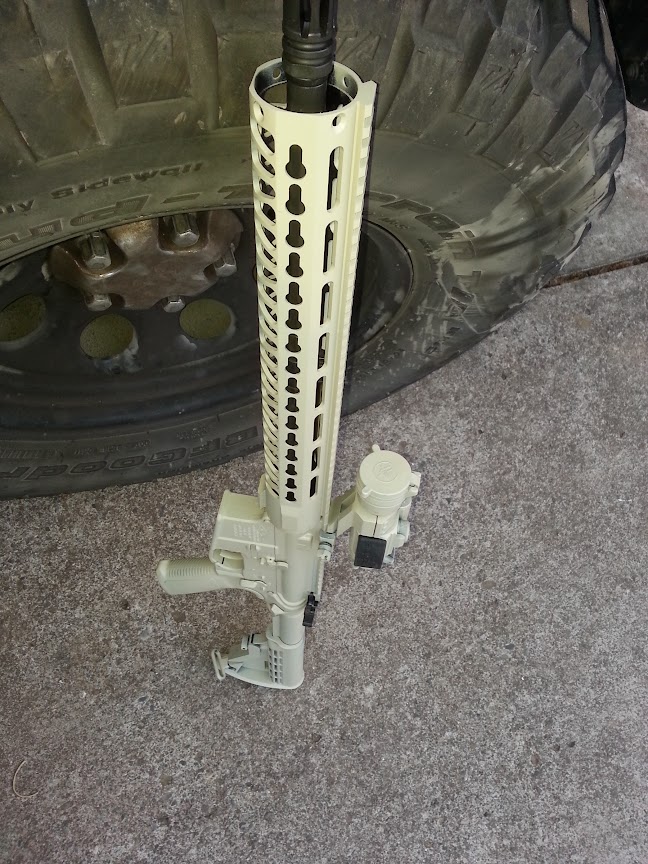
AR base coat

AR base coat

This weekend I am going to use the stencils and finish up the camo pattern. Check back on Monday for that post. My goal is to make something that looks very similar to multicam and blends well with my other gear and my surroundings.
  • Share on Tumblr