Author Archives: Woodsbum

Kuksa – The Bushcrafter’s Coffee Cup

by Woodsbum

There are many, many really cool things that you learn about when diving into the whole “bushcrafting” world. Different techniques for doing things that you have done for years, re-purposing old gear, making your own kit items, and learning about things that you didn’t even know existed are just some of the ways in which an outdoors-person can benefit. When I ran across wooden eating/drinking items, I was not too sure at first. After time, I found that building these things didn’t just help me to become better with cutting tools, but it also helped me to think differently about what I truly needed to carry with me into the woods. Although my spoons, bowls and cups are not ready for prime time I wanted to pass along the whole idea of making your own items. When I make something that is more than one step above functional, I will include pictures and do a post on it. Until then, please learn about the “kuksa.”

Kuksa and Guksi originate from Scandinavian drinking cups that were made from birch burls. Now a days you can find them from all sorts of varied wood types, but they are basically the same concept. They are hollowed out pieces of wood that make a cup shape and have a handle. Not a big innovation of design. They are, however, very nice to use. The ones that I have made seem to cool my coffee to a drinking temperature almost instantly and keep it there for a relatively decent amount of time. They also give something I like to call “style points.”

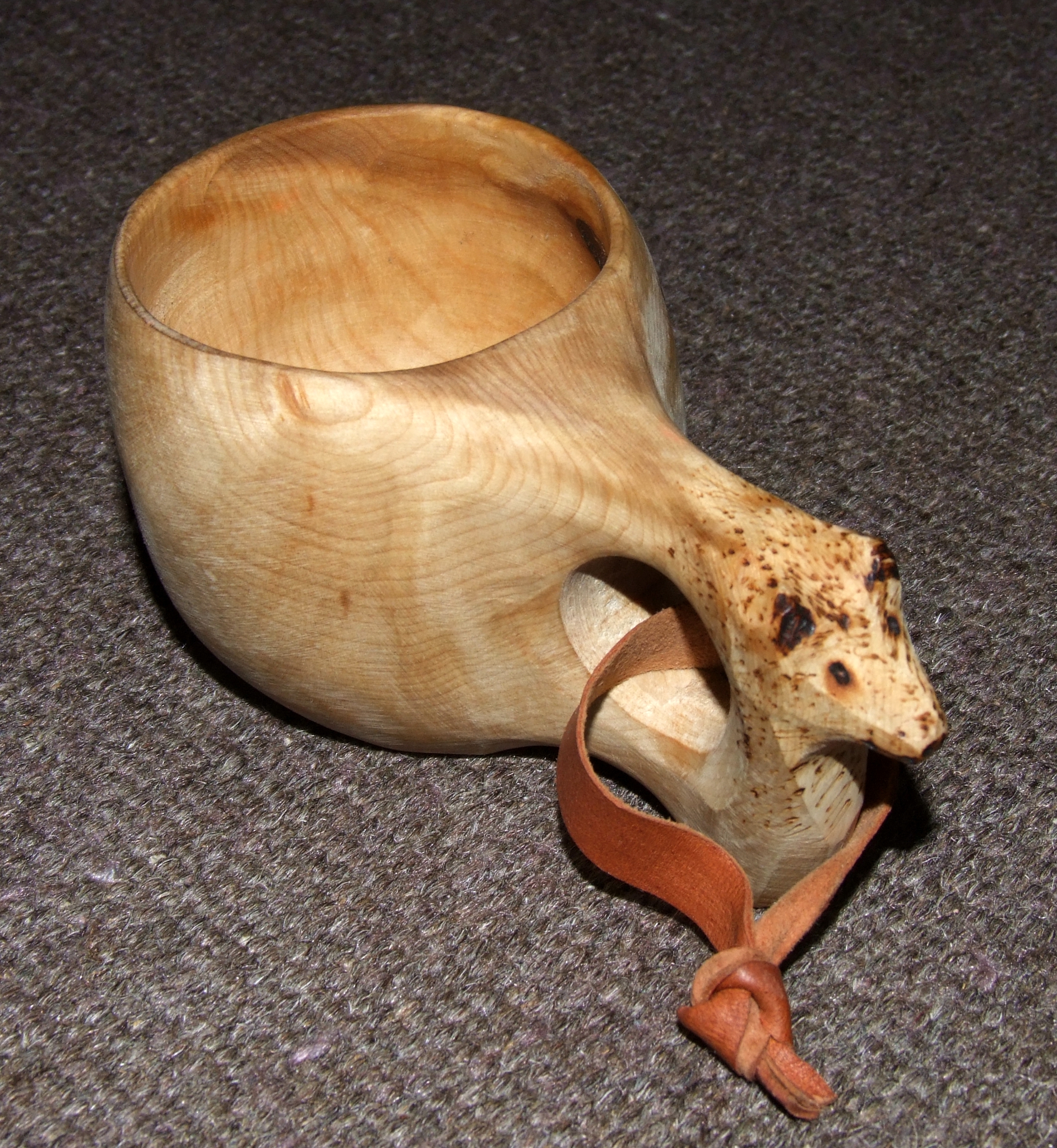
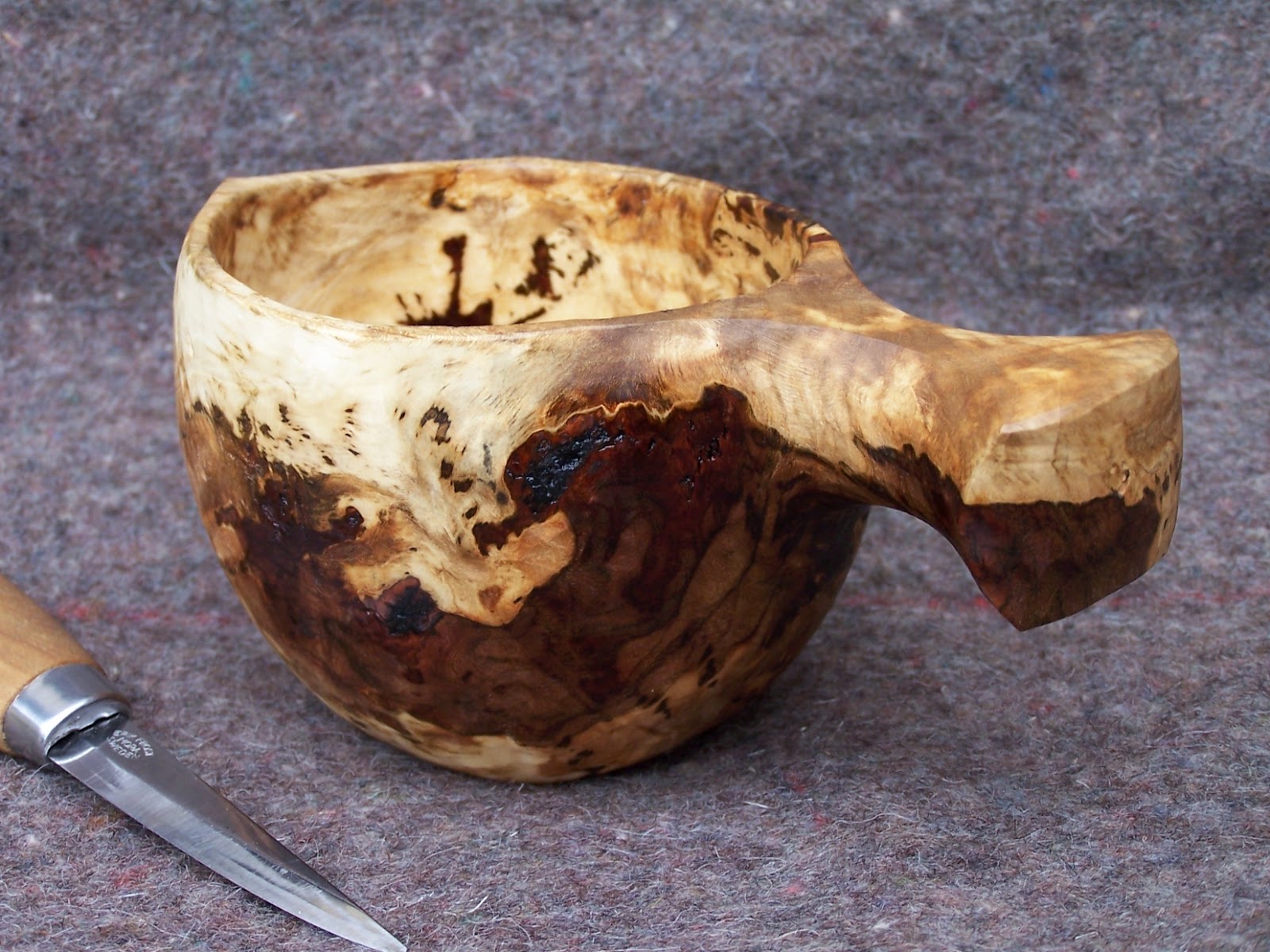
Here are a couple pictures of different kuksas so that you have an idea of what I am talking about.

Kuksa

Kuksa

Kuksa

Kuksa

As you can see, they differ in shape and handle style. The only common thread that they really seem to have is that they hold liquids and have a handle of some sort. Many are hand carved in the traditional construction method. Many are also done by machine or a combination of machine, knife and axe. Once completed, they are soaked in some sort of a non toxic oil, like vegetable oil, and allowed to dry so that they don’t crack out.

Here are a few videos on construction.

And another one:

Again, these are beautiful and function pieces of equipment that can either be carved or machined, all depending on your skills. So, grab some wood chunks and get to work making your own. It is a rewarding experience that can become a bit addictive over time.

  • Share on Tumblr

Wild Boar Blades Trout and Game Knife

by Woodsbum

I can’t remember exactly, but it was about 18 months or so ago I saw an advertisement in The Backwoodsman for a nice little trout and game knife made by Wild Boar Blades. I called the number to get some pricing and information. Come to find out, the maker has a shop out in Silver Lake, WA and answered his own phone. The gentleman seemed like a great guy so I went ahead and ordered one of his knives.

Shipping was quick and the price was good considering I was getting something from a custom knife maker. Some of my custom knives have been over $600, so this was almost “chump change” in comparison. Again, I will say that the maker himself was great to talk to over the phone and the pictures of his work made his knives appear quite good. Then I got it in the mail……

Now I don’t want to pick apart someone’s work nor do I dislike the knife enough to not use it. There were just some quality issues that need to be addressed before I feel that it should have been released from the work bench.

First, let me show you the knife.
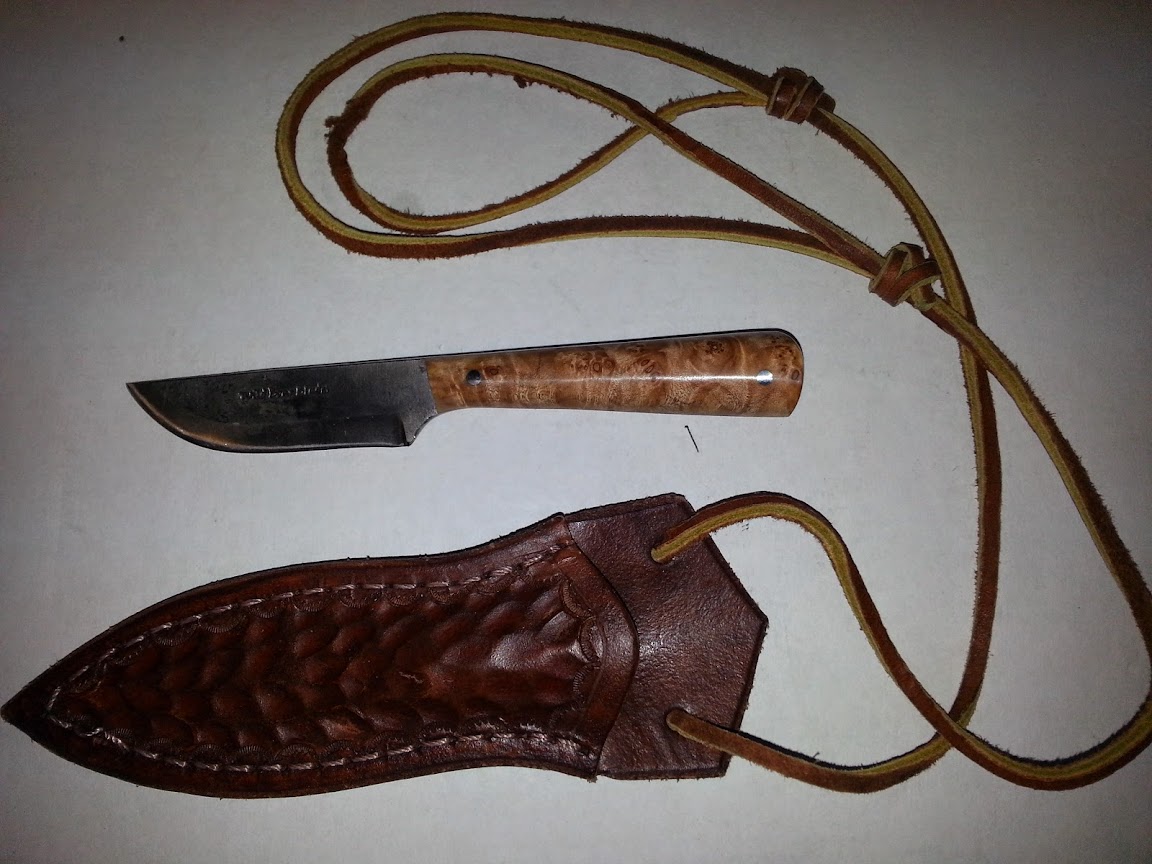
Wild Boar Blades Trout knife

Wild Boar Blades Trout knife

As you can see, it looks nice from the pictures. Mind you, I have used the heck out this knife and both it and the sheath have seen better days. There are a couple maker errors that I found when I first got the knife, however. The first thing that I noticed was that the handle scales were not even. The maker did not square off the butt evenly and now there one side is annoyingly longer than the other. It is hard to see in this picture, but if you look closely you can see it.
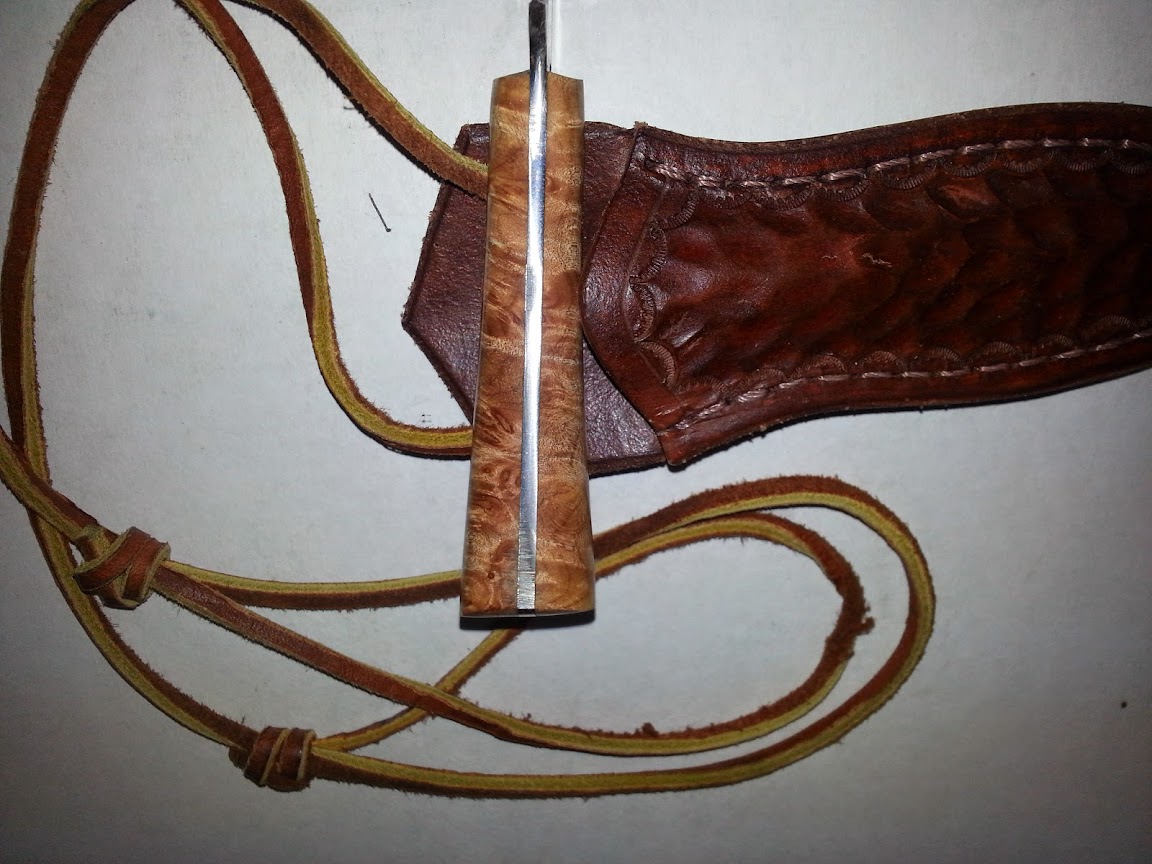
Crooked scales

Crooked scales

You can also see the grinding marks on the tang right at the butt as well as crookedly ground scales up toward the top of the scales.

The grind on the blade was also way too sharp of an angle. It would not hold an edge at all. It took me several hours on a stone to get the angle to a workable angle. As you can see here, I did not do a perfect job. It is a lot better than it was, however. The blade came with a very sharply angled convex grind to it. The way it was done made it where the blade did not hold an edge nor could I get it very sharp. A flatter or more tapered grind would have been a better choice for this knife considering it was designed for cleaning trout and small game. It really came as more of a patch type knife than anything else. I still have many hours left to make it perfect, but considering the other flaws I will just let time and strop sharpening fix the edge.

The other issue that will require my attention is the stitching of the sheath. Even though the sheath is not evenly cut and the stitches were not properly aligned to the edge, the real problem is that the maker used an easy stitch with unwaxed thread. Of course the thread broke and is now in need of a complete restitching job.
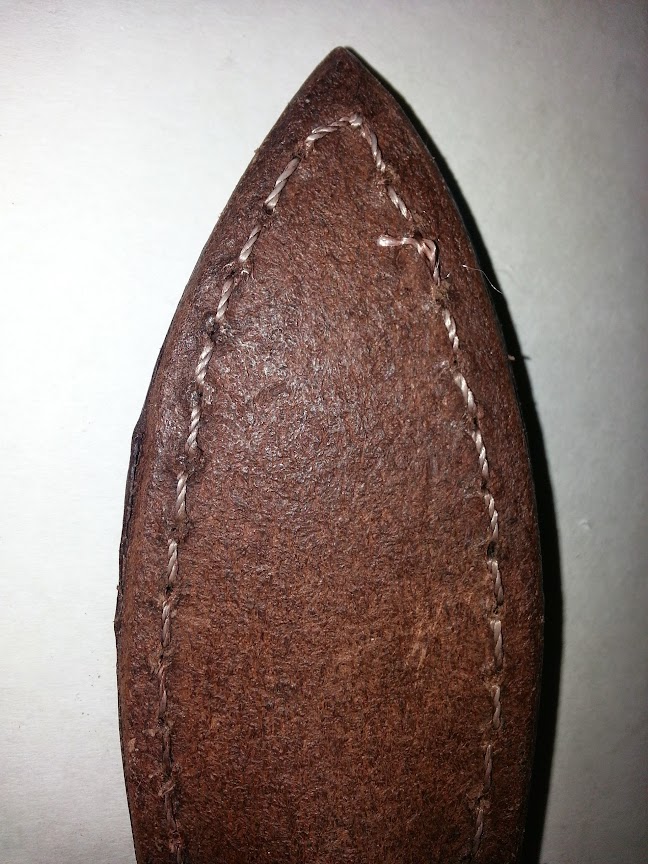
Broken stitching and uneven edge spacing

Broken stitching and uneven edge spacing

Now don’t get the idea that I hate the knife. The finish sanding and polish of the scales is awesome. The design and shape is phenomenal as well. I even like the maker’s mark and name of the blade company. I just think that there are some build and quality issues that need to be addressed.

As a side note, I have used this knife quite extensively to clean small game and fish. It has cleaned 20-30 trout, several dozen ducks, a dozen or two rabbits, probably a 100 doves, countless squirrels and helped bone out my son’s deer. After flattening out the edge on the blade it is now sharp enough to work as it was originally intended. Again, it has a long way to go. As you can see below, it is sharp enough after meating out several racks of ribs last night to still cut paper without issue.
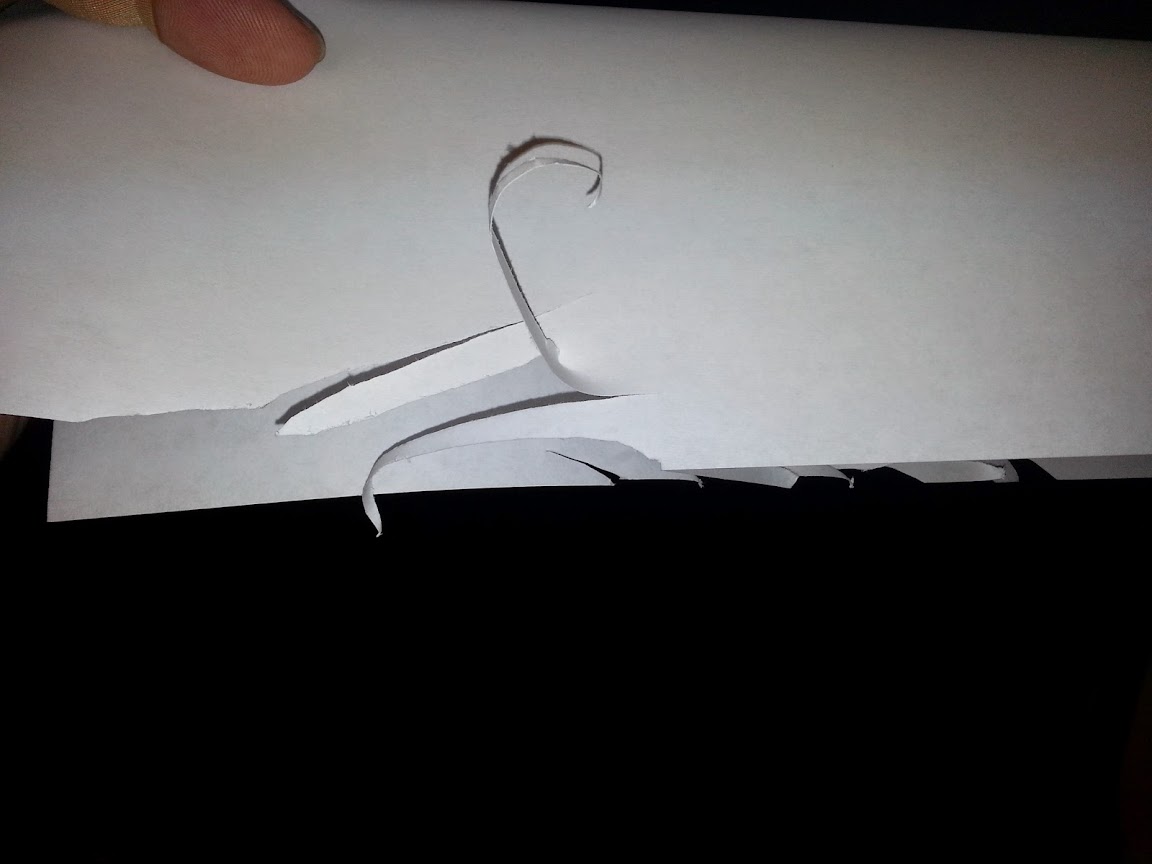
Sharp enough for now

Sharp enough for now

If you have the skills to fix the blade when you get it or are like me and don’t care too much about using a blemished custom knife, I would recommend the shape and design of this knife. If you want a show piece or don’t know how to fix the edge of a knife to make it more suited for cutting up meat then I would recommend you look elsewhere.

  • Share on Tumblr

Smoking Meat at a Campsite

by Woodsbum

I have been smoking meats while at camp like this for a while, but do not have a video camera to record the process. One of these days I will purchase a GoPro, but just have not spent the money yet. This video shows the basic idea and premise for smoking meat over a campfire. I have found that using bark to build a little structure around several wooden racks works quite well. I am also partial to using my squirrel cooker to put the meat on and then surround my dinner with a bark structure, that way I can use the rotisserie feature of the cooker. When it gets a bit drier I will do a post on squirrel cookers.

Here is the instructional video. Very well done.

  • Share on Tumblr

Benchmade Barrage Model 581

by Woodsbum

For many years I carried an old Ka-Bar folding knife as my EDC. It holds an edge and works fine, but it was not really big enough for my hand and it has a serrated section. I am fine with serrated blades, but I would rather have all or none. This is just personal preference based upon the way I use a knife. Luckily, I was able to pick up a beautiful and functional EDC that seems to suit my needs a bit more. It is the Benchmade Barrage Model 581.

Benchmade Barrage Model 581

Benchmade Barrage Model 581

Now there are several different models of the Barrage. This one is the more expensive one with some nicer features, but there is one that is about $100 less expensive (Model 580). I have one of these as well, but never carried it or really used it much. The size and blade shape was great, but I didn’t like the handle or the steel used. Their Model 581 is much nicer. Here are the specifications:

Blade Length: 3.60
Blade Thickness: 0.121
Handle Thickness: 0.650
Blade Material: M390 Super Steel
Blade Hardness: 60-62HRC
Weight: 5.20oz.
Pocket Clip: Reversible, Black, Tip-Up, Split Arrow
Lock Mechanism: AXIS-Assist
Overall Length: 8.35
Closed Length: 4.75
Sheath Material: Sold Separately
Class: Blue

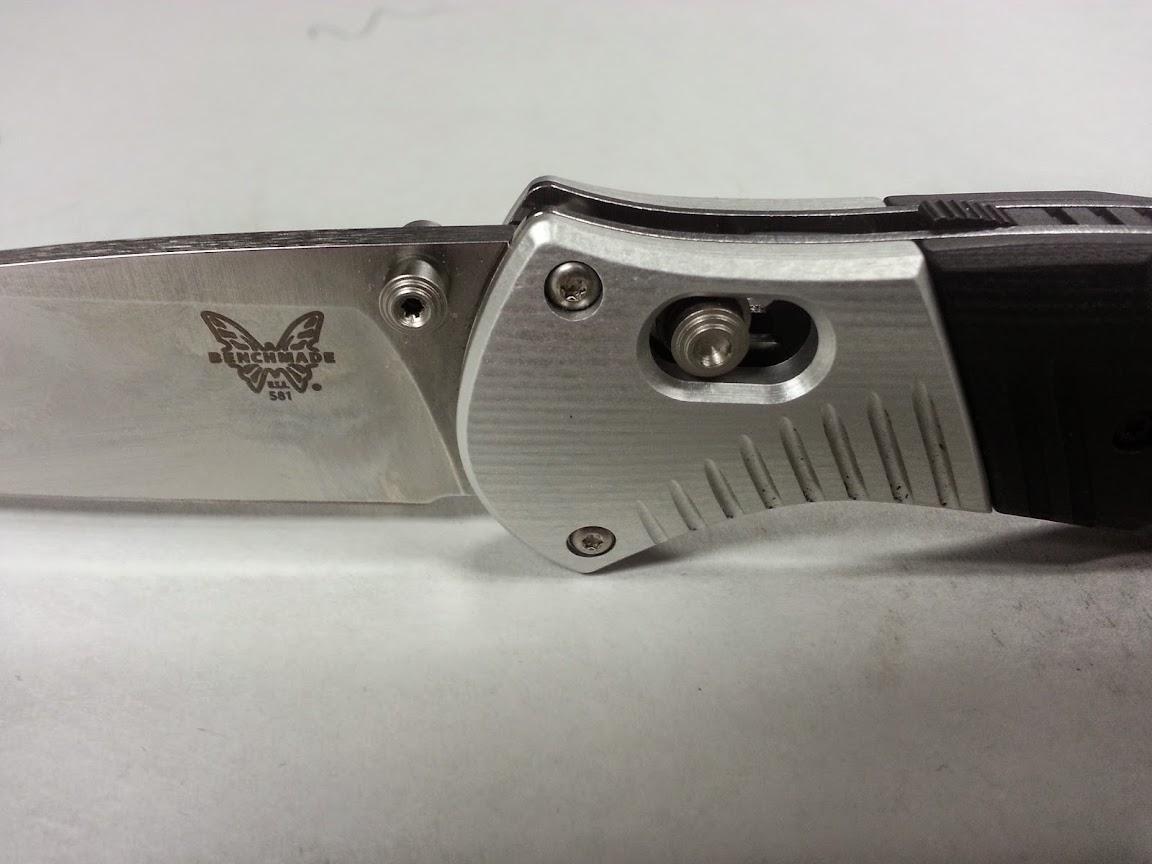
Like it’s less tricked out brothers, the 581 also has the same locking mechanism. This thumb slide locks the blade so the spring assist doesn’t allow it to open in your pocket, but also locks the blade release so it won’t close either. It is a very nice feature to ensure you don’t stab yourself in the leg when carrying the knife while working. All you really need to remember is to push down on the slide a bit with your thumb and it will easily click into either locked or unlocked position.

Benchmade locking mechanism

Benchmade locking mechanism

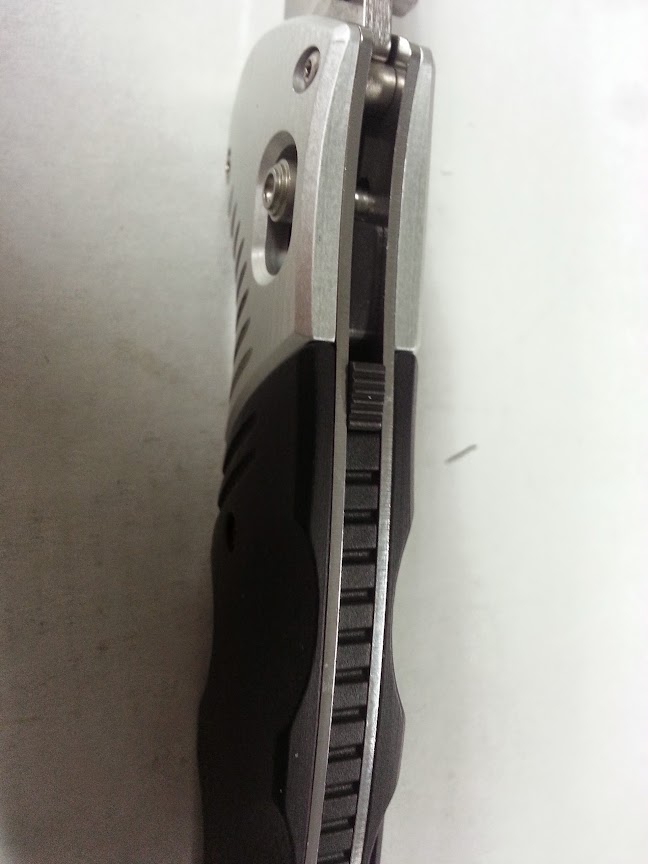
This is the blade locking mechanism. When the blade is out, just slide this guy back and it will release the blade. It is quite secure and takes one heck of a beating without failing. I have yet to have the blade release on me with either this model Barrage (Model 581) or the Model 580.

Benchmade blade locking mechanism

Benchmade blade locking mechanism

The last big difference between this model and the others is the steel that is used. Instead of the 154CM that comes on the 580’s, this has a “super steel” called M390. It is supposed to be a super performance, high tech steel that actually starts off with iron powder for better mixtures and is used in surgical cutting instruments. The edge is hair popping and it does seem to hold an edge like no other EDC knife I have ever had.

As to why I like this type knife, there are several reasons. Many knifes come in with the drop point and have a good, solid handle like this that makes it easy to grip. Here are a few other features that I personally like.

  • Drop point: For what I use an EDC knife for, this is just a perfect blade shape. It is easy to touch back up with a strop, I can do basic carving with it, and I can use most of the blade’s cutting surface for 90% of my jobs. Just my preference and usage needs.
  • Convex grind: This has a convex grind with a secondary grind for the edge. I really like this grind versus a hollow ground knife, like most EDC options out there. Again, it is just my preference.
  • Ambidextrous thumb studs: Because I use my knife with both hands, this is an important feature for me. My old EDC did not have them and I found that I had to do a lot of transferring the knife or opening it in odd manners with my left hand. This has made life much easier for me.
  • Handle material: The 580 has a Valox handle that is ultra lightweight and just doesn’t give me the personal “feel” that I want out of a knife. This 581 uses G10 and and aluminum bolster which gives me the feel and weight that I prefer. The Valox holds and my hand doesn’t slip off it, but it just feels too light and throws the balance off in my hand. Many people (my son included) like the Valox, which is why the 580 is now his….

This knife retails for around $200. This is much more money than many people are will to pay for a pocket knife. I know that. Considering what a knife snob I am and how I like my “kits” that I build for each individual purpose, spending $200 for something that will actually span all those “kits” is something that I can justify. If you are looking for a good, all around EDC knife that will supplement all your heavy use fixed blades in your kits then the 581 might be the one for you.

  • Share on Tumblr

Another Foraging Resource – Eat the Weeds

by Woodsbum

Although I am one heck of a hunter, fire builder, shelter constructor, decent at tracking (how I recover game due to color issues with red on green), fisherman, and all around outdoors guy I do have a problem with foraging. This has been one area of my training that I have really been lacking in and I know it. Unfortunately, I also have no one that I hang around with in real life that is capable of pulling me along and training me. It has really become a lost art and difficult to learn on your own. This is why I buy so many foraging references and am constantly on the lookout for good references. Since I found another place that I have been creeping around in hopes of learning a bit, I felt compelled to include it here for my own future reference…..  If you find it helpful then I am also happy about that.

Eat The Weeds is a blog by Green Deane that I stumbled across a few days ago. He also has a YouTube channel that you can head over to if you so desire. It is really very good and well put together. The only problem is that he assumes that you have a starting knowledge of botany and plant identification. It is actually getting to the point where I am thinking about taking a few plant identification classes at our local college to get me started. This would be an expensive way to overcome the knowledge deficit that I have regarding greenry, but it might be the most beneficial considering. I will keep you updated if I decide to take that path.

I am also waiting to get my “acceptance” email from his forums. I hope to be granted access to that section of his site fairly soon so that I can start hitting up those bubbas about plant identification resources for us “filet and release” types.

Green does offer classes at a reasonable price, but you have to be in Florida to attend. That really does not do me any good considering I am on the entirely opposite side of the continental United States. This also doesn’t take into account the fact that the plant life down there is going to be much different than what we see up here.

As I get more information or resources, I will post them here on AOD. If you have any suggestions or good places for me to check out, please add a comment.

  • Share on Tumblr