

Category Archives: Emergency Preps

Anything that can be thought of as preparedness or preparedness related.

Fish Antibiotics

by Woodsbum

Because of my previous medical training, I tend to try and take care of a lot of my own ailments whenever I can. Much of that ability has been stripped due to no longer being Active Duty (can’t write my own scripts anymore), but when I can find some sort of supplement or OTC combination that will fix my problems I don’t hesitate to make it work. I have now found an emergency solution to my lack of access. Enter fish antibiotics….

Now mind you that I AM NOT GIVING YOU MEDICAL ADVICE. I am just passing along information that peaked my attention.

This article was copied from another website, but is very well written. I have copied and pasted it from this link:

***************************************************************************

I have found a very interesting article on JWR’s Survival Blog. The article allegedly written by an emergency doc offers suggestions on using fish antibiotics as well as basic indications on which meds to use per ailment. This is the best such article I’ve read. Copied below for your enjoyment:

First, the disclaimers: Nothing in this article constitutes medical advice. It is for information purposes only. It is not meant to diagnose or treat any disease. Fish antibiotics are not for human consumption. Never take any medication that was not prescribed specifically for you by your physician. Hopefully, this information can help you be a more informed and involved patient. Short of a true post-SHTF scenario, I strongly advise you not to self-diagnose and treat. (Health care professionals are especially notorious for doing this.) I have seen significant harm come to many patients because of this. Recently, someone killed off their kidneys because they took cow doses of antibiotics. As long as doctors, nurses, and other providers exist, please use them! I say this not to drum up business (believe me, if anything I want less business in my emergency department), but rather for concern for the significant harm that I have seen happen to patients time and again.

I have just received my order of fish antibiotics. (For my fish, of course!) As a physician, I could easily hit up one of my colleagues to write me a prescription for any number of medicines. So, why order fish antibiotics from the internet? I live in a state with a medical board who likes to go on witch hunts for “non-therapeutic prescribing,” and I would not want to cause one of my co-workers to be the target of an investigation. (This is a common reason your physician might not be too willing to prescribe medications for your personal preparations.) Also, I was curious to see if they would come as advertised.

When the bottles arrived, I dug out my photographic drug reference and found that these are indeed the same pills that are given to humans, right down to the tablet color and markings. It makes business sense. It costs less for drug manufacturers to have one production line for each drug, rather than to build a separate process exclusively for veterinary medicines. These are the same generic antibiotics that can be found on many pharmacy formularies on the “4 dollar” list. They cost more to purchase as veterinary antibiotics, but are not prohibitively expensive. (Please remember SurvivalBlog advertisers when shopping around.)

After checking my order, I placed the bottles in airtight bags and put them in the fridge. The general consensus is that antibiotics will still retain most of their potency for years after their expiration date, especially if kept cool and dry. The notable exceptions are tetracycline antibiotics, including doxycycline. These can cause kidney damage if taken after their expiration dates.

The antibiotics I ordered were (US brand name in parentheses, if in common usage):
Amoxicillin (Amoxil)
Cephalexin (Keflex)
Metronidazole (Flagyl)
Clindamycin (Cleocin)
Ciprofloxacin (Cipro)
Trimethoprim/sulfamethoxazole (Bactrim, Septra)
Doxycycline
Erythromycin

Judicious use of antibiotics

First, we must know when not to use antibiotics. When they become a precious commodity they will need to be used very wisely. Many of the patients I see in the adult emergency department, and most of the patients I see in the children’s Emergency Department for various types of infections do not need antibiotics.

There is also a growing and very real danger with antibiotic resistance. It is a very legitimate fear that we may use antibiotics to the point that they are no longer effective, at which point it will be just like it was in the pre-antibiotic age.

Also, antibiotics are not completely innocuous. They have the potential to cause harm. (All medicines do, including the “safe, natural” remedies.) Allergic reactions are common, and the only way to become allergic to a medication is to be exposed to it in the first place. Drug reactions are also very prevalent, and range from the annoying (e.g. rash, diarrhea), to the life-threatening (e.g. skin sloughing off in sheets, causing the equivalent of a bad total body burn.)

Most infections involving the nose, sinuses, throat, and respiratory tract are viral and will not respond to antibiotics. Even some presumptive bacterial infections like otitis media (the common middle ear infection) will usually do just fine without antibiotic usage. If you have one of the following, think twice before using your precious antibiotic supply:

Cold, cough, runny nose
Sinus pain or pressure
Bronchitis (coughing up phlegm)
Ear pain or pressure
Sore throat (there is debate about whether even strep throat needs antibiotics)

Obviously, this list is oversimplified. For example, a middle ear infection can spread to the bone around it and cause mastoiditis. The difference between a viral bronchitis (not requiring antibiotics) and a bacterial pneumonia (requiring antibiotics) can be difficult to distinguish. Doctors, lab tests, and x-rays frequently get this wrong. If symptoms persist for an extended period, or if you are getting worse, it may be more complicated than a simple viral infection.

When and how to use antibiotics

Which antibiotics to use is always a big subject of debate. A roomful of physicians will seldom agree on the proper treatment of any disease, much less antibiotic use. In fact, there is a medical specialty (Infectious Disease) in which physicians train for 5 years after medical school so they can run around the hospital and tell other physicians what antibiotics they can and cannot use.

If you are going to use antibiotics, remember some guidelines. (Again, for information purposes only.) Dosages are given in milligrams (mg). Pediatric doses are given in milligrams per kilogram (mg/kg). All dosing notations here assume they are taken orally.

What follows is a list of common diseases and the antibiotics that treat them, limited to the list available above. Remember that there are many antibiotics, most of which are not listed here.

Pneumonia/bronchitis—doxycycline 100 mg twice a day for 7-10 days, erythromycin 500 mg every 6 hours, amoxicillin (more often used in children) 45 mg/kg two times a day for 10 days. Ciprofloxacin can be used in conjunction with another antibiotic, but it is not commonly considered a “respiratory drug.” Its sister drugs, levofloxacin and moxifloxacin, are, but are not available without a prescription.

Ear infection—adult: amoxicillin 500 mg 3 times a day for 7-10 days, children: amoxicillin 30 mg/kg 3 times a day for 7-10 days

Sinusitis—amoxicillin 500 mg 3 times a day for 10-14 days, doxycycline 100 mg twice a day for 7 days

Sore (strep) throat—amoxicillin 500 mg 3 times a day for 10 days (child 25 mg/kg two times a day for 10 days), clindamycin 450 mg three times a day for 10 days (child 10 mg/kg three times a day for 10 days)

Intra-abdominal infections (diverticulitis, etc)— ciprofloxacin 500 mg twice a day PLUS metronidazole 500 mg three times a day for 10 days

Infectious diarrhea—ciprofloxacin 500 mg twice daily for 5-7 days

Urinary infection—child-bearing age females without a fever who are not pregnant: trimethoprim/sulfamethoxazole 160/180 mg two times a day for 3 days, ciprofloxacin 250 mg twice a day for 3 days; pregnant female: cephalexin 500 mg twice a day for 7 days, amoxicillin 500 mg three times a day for 7 days; other adults: ciprofloxacin 500 mg twice a day for 7-10 days; children: trimethoprim/sulfamethoxazole 5 mg/kg twice daily for 7 days (this dosing is based on the trimethoprim portion, which is usually 160 mg per tablet)

Bacterial vaginosis—metronidazole 500 mg twice daily for 7 days, clindamycin 300 mg twice daily for 7 days

Skin infections— trimethoprim/sulfamethoxazole 160/180 mg (child 5 mg/kg) two times a day AND cephalexin 500 mg (child 6.25 mg/kg) four times a day for 7-10 days, clindamycin 300 mg (child 10 mg/kg) four times a day for 7-10 days, doxycycline 100 mg twice a day for 7-10 days. (Methicillin-resistant staphylococcus aureus, aka MRSA, is a consideration in all skin infections nowadays.)

Not common household diseases, but possible biological weapons:

Plague (Yersinia pestis) post-exposure prevention—ciprofloxacin 500 mg twice a day for 7 days, doxycycline 100 mg twice a day for 7 days
Anthrax (Bacillus anthracis) post-exposure prevention—ciprofloxacin 500 mg twice a day for 60 days, doxycycline 100 mg twice a day for 60 days

Caution! Do not cause harm to yourself or others.

Beware of allergies. If you are allergic to a medication avoid any drugs in its same family. Some of the families are related, such as penicillins and cephalosporins. Depending on where you read, there is a 2-10% cross-reactivity. However, as long as the reported reaction is not serious (e.g. a simple rash when someone takes penicillin), I will often give cephalosporins to penicillin allergic patients.

Antibiotic classes:

Please note that these lists are not comprehensive:
Penicillins (“-cillins”): amoxicillin, ampicillin, methicillin, dicloxacillin
Cephalosporins (“cef-”): cephalexin, cefaclor, cefuroxime, cefdinir, ceftriaxone, cefepime
Lincosamides: lincomycin, clindamycin
Fluoroquinolones (“-floxacins”): ciprofloxacin, ofloxacin, levofloxacin, moxifloxacin
Sulfa drugs (this is a very broad category, and includes many non-antibiotics): trimethoprim/sulfamethoxazole, sulfasalazine, dapsone
Tetracyclines (“-cyclines”): tetracycline, doxycycline, minocycline
Macrolides: erythromycin, azithromycin, clarithromycin

Not all antibiotics can be used across all patient populations. Pregnant women, breastfeeding women, and children deserve special consideration. Although some antibiotics should be avoided in certain patients, there is always a risk/benefit consideration. For example, if my pregnant wife developed a life-threatening pneumonia, and all I had was doxycycline, I would give it to her and accept the risk to the baby.

Avoid in pregnancy:
Ciprofloxacin (Cipro)
Trimethoprim/sulfamethoxazole (Bactrim, Septra)
Doxycycline

Avoid in children and breastfeeding women:
Ciprofloxacin (Cipro)
Doxycycline

I recommend getting some good references, mostly in EMP-proof paper editions. These can often be picked up for free, as local physicians shed their bulky paper medical libraries in favor of putting everything on a portable smartphone or tablet. I picked up several copies of the Physicians’ Desk Reference this way. I think it is aptly named because it is the size of a desk. However, it sure is good fun to shoot with various pistol calibers to see how many pages they will penetrate. For a more portable version, I like the Tarascon Pharmacopoeia and the EMRA Antibiotic Guide. Many of the regimens listed in this article are referenced in these books.

——-

Antibiotics Cephalexin – Fish Flex – Forte
Antibiotics Amoxicillin – Fish Mox – Forte
Antibiotics Penicillin – Fish Pen – Forte
Antibiotic Metronidazole – Fish Zole
Antibiotics Doxycycline – Fish Doxy

The article can be found at http://www.survivalblog.com/2013/11/so-you-bought-fish-antibiotics-now-what-by-tx-er-doc.html Worth printing and keeping as reference. ***************************************************************************

Now I am not saying that everyone should run out and start treating themselves with these medications. I am saying that this is a great reference for emergency situations where you can pull this information for such things as Trivial Pursuit, don’t feel like Googling, or the sort. If you are not a medical professional, do not try this at home and say that I told you to. I did no such thing.

  • Share on Tumblr

Ham Radio Starter Kit for Emergencies

by GunGuy

Warning: If you TRANSMIT on frequencies reserved for HAM radio without a license you will be considered a “Pirate”. This is against FCC regulations and they can find you, fine you and take all your radio equipment.

Having reliable communications is always important but it is essential during times of crisis. I think it is imperative that you and your family have reliable communications in times of an emergency or disaster. If the power goes out and the landlines and cell towers are disrupted having the ability to communicate and gather information prevents you from feeling isolated and hopeless.

Keeping the above in mind and also wanting to price out a budget friendly starter package for the beginning ham radio enthusiast or SHTF emergency contingency I recommend the following. It’s cheap, works well and it is easy to add more radios as needed.

So after ordering several of the items listed above I have:

  • 2 Baofeng 2-way radios.
  • 2 Expert Power 7.5″ antenna upgrades. These are flexible and will not snap like the antennas that come with the radios.
  • 2 Handheld Mics. Good for clipping to your shirt.
  • 2 Spare batteries.
  • 1 Car charger. This plugs into the charging cradle and not the radio directly.
  • 1 genuine Baofeng programming cable

For a total of $152.57 I have two radios with upgrades and accessories which is less than one Yaesu FT-60R handheld.

List of frequencies included in the Chirp Emergency Radio Config IMG file here and Emergency Radio Config CSV file here. Same info different file formats.

In order to get you started on obtaining your HAM radio license here are two excellent resources. National Association for Amateur Radio and eHam.net Practice Exams. The test is relatively easy to pass and just reading the Ham Radio License Manual published by the ARRL will be enough. You can cram for the test by reading the Q&A’s in the back over and over till you get them down.

1 70SPX1 446
2 2SPX01 146.52
3 2SPX02 146.535
4 2SPX03 146.55
5 2SPX04 146.565
6 2SPX05 146.58
7 2SPX06 146.595
8 2SPX07 147.42
9 2SPX08 147.435
10 2SPX09 147.45
11 2SPX10 147.465
12 2SPX11 147.48
13 2SPX12 147.495
14 2SPX13 147.51
15 2SPX14 147.525
16 2SPX15 147.54
17 2SPX16 147.555
18 2SPX17 147.57
19 2SPX18 147.585
20 FRS1  462.5625
21 FRS2  462.5875
22 FRS3  462.6125
23 FRS4  462.6375
24 FRS5  462.6625
25 FRS6  462.6875
26 FRS7  462.7125
27 FRS8  467.5625
28 FRS9  467.5875
29 FRS10 467.6125
30 FRS11 467.6375
31 FRS12 467.6625
32 FRS13 467.6875
33 FRS14 467.7125
34 GMRS1 462.55
35 GMRS2 462.575
36 GMRS3 462.6
37 GMRS4 462.625
38 GMRS5 462.65
39 GMRS6 462.675
40 GMRS7 462.7
41 GMRS8 462.725
42 MURS1 151.82
43 MURS2 151.88
44 MURS3 151.94
45 MURS4 154.57
46 MURS5 154.6
47 NOAA1 162.4
48 NOAA2 162.425
49 NOAA3 162.45
50 NOAA4 162.475
51 NOAA5 162.5
52 NOAA6 162.525
53 NOAA7 162.55
54 MVHF16 156.8

  • Share on Tumblr

Debris Huts

by Woodsbum

Considering the “Arctic Freeze”, “Polar Invasion”, “cold front that made me shiver in my Jockeys”, or whatever you decide to call it that just rolled in, I decided that a quick post on making a debris hut might be a good idea. For those of you who do not know what a debris hut is, just think of a framed in structure with lots of leaves and branches over the top for insulation.

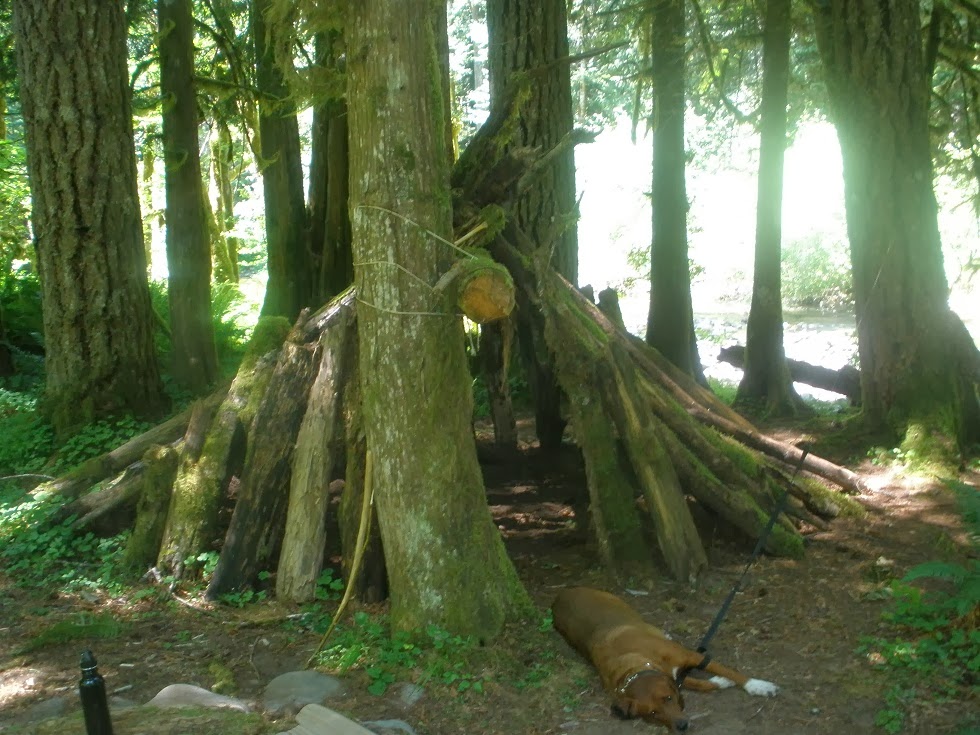
Here is the structure of one that we use when the bad weather comes in and we get stuck up in one of our camping areas. As you can see, my lazy hound likes it.

Debris Hut Frame

Debris Hut Frame

Debris Hut Frame

Debris Hut Frame

I first found this structure while hiking up in the hills. Later on I found that this has been used quite extensively by several trail crews and hikers that get caught in bad weather. There are piles of downed boughs and debris from previous users of the hut not far off. During the summer months, however, it seems to be more used for people to put a tarp over one side while leaving the other side open for ventilation. Although this is not the best example of a debris hut, it does give you a real world picture of what these types structures can be used for as well as their versatility.

Because I have never felt it necessary until now to have pictures of the building process, I am going to borrow a bit from the Internet. Here is a link to Wiki-How’s page on building them. I would like to toss out that the biggest reason that these type structures fail is due to a poor ridgepole and supporting structure. Many times I have found my friends scrambling to get out of their collapsed structures. Even though I find it humorous, they do not and in a real survival type situation this type thing could be bad.

This video is done by a very skilled bushcrafter that I know from BushcraftUSA. There are dozens of these type videos out there, but considering I know him from the Internet I felt that his was the best to use.

There are numerous variations of these type structures that are only hindered by your imagination. The important thing to remember is that you will need some strength to the frame and lots of insulation on top to ensure you don’t get cold/wet.

I hope everyone found this post informative. If you want even more resources on woodman structures, I suggest you get this book. About any type structure you would want to build is covered in this book. It also goes over such necessities as heating and waterproofing. It is truly a great resource.

Shelters, Shacks and Shanties

Shelters, Shacks and Shanties

  • Share on Tumblr

Wyoming In the 1980’s Oil Bust – Part 2

by Woodsbum

My last post talked about what Wyoming was like when I was there in the early 80’s. It was a very difficult time and it caused us to live through what some would consider a SHTF type scenario. I know it really forced me to make changes in my life to cover my family if something like this ever happens again to us. Luckily, we were able to make it through by simply adapting and overcoming things as best we could. Eventually we did have to move to Texas with whatever we could salvage, but lasted for about 5 years before we lost our home. Considering how bad it was, we did pretty well.

This is how our family ended up making it through the ordeal.

Many of our friends were Mormon, which really saved our rear ends. My father would get me from school and take me out to go shoot wild game. I would bag a deer, antelope, rabbits, grouse, or some other wild meat, clean it, bone it, and bring out the meat in garbage bags and a backpack. We would use much of that meat, but would trade what we could to our Morman friends for canned items and other food stuffs. The one year I know I had to have harvested a couple dozen large game animals just myself. This was when I was in my later years of grade school (5th and 6th grade).

We were literally so poor, but still holding on, that I had to make and wear moccasins because we didn’t have the money to buy me new shoes. They were double hide buck skin that I had shot previously and ugly as sin. To this day I have a weird thing where I have to keep several pairs of shoes around me, even in my truck and under my desk at work. It just really messed with me and I still freak out when my kids (now grown) don’t have several pair as backups in case something happens.

At that time there was a bounty on coyotes. My father would get me from school and we would head out during the week to go get enough to make the difference in our house payment or electricity bills. I remember that the bounty was up to $75 per set of ears at one point. We would go out early in the morning and harvest a few rabbits that we would “fillet and release” back into the wild. In another words, we shot them and then spread their entrails around the fields after we cooked up the meat for breakfast. We would then call in the predators and shoot whatever had a bounty. Every once in a while we would get a fox. Those didn’t have a bounty, but we could sell the fur for over $100 if we didn’t mess it up too badly with the rifle.

My father and I would also hire out on farms and ranches to repair different equipment. I was only a kid, but I was very capable and proficient with driving different types of heavy equipment. Since my dad could fix almost anything and was an excellent welder, I would get a few extra dollars for us by running a tractor for such things as haying crews, mowers, etc or crane for scrappers pulling old oil gear. It was bad enough at times that I actually missed a few months of school here and there to help my father out on the road while he did mechanical work or welding.

Now what all did I learn from this 5 years of hell? That is a good question. I can tell you what some of the skills I know possess are and what changes in my life are a direct cause of this time growing up:

  • I know that I can hunt and fish efficiently enough to feed myself. This includes processing, preserving, and even smoking the meat to ensure the supply will last. Many may scoff, but that is how we ate and lived for 3 of those 5 years in Wyoming.
  • It is necessary to buy items that will be eventually used when you have the money. This includes ammunition, food, equipment, etc.
  • Learn from everyone even if you don’t agree with their religion or philosophy. The LDS church is huge on food preps and saving things for a rainy day. Many Asian cultures are also of this mindset. Interestingly enough, they all have their skills that many people “poo-poo” because of whatever reason.
  • Don’t be afraid to trade skills for items you need. I remember helping to process and butcher a moose in exchange for a portion of the animal. We ate on that for several weeks.
  • No situation is cut and dry. It will also change at least daily if not several times over the course of the day. After our family got set up with trading wild game for other food items, many other people started joining in. This also happened with the bounties on coyotes. It went from $75 per set of ears to $5 if I remember correctly. We ended up having to adapt and change how we made extra money several times and as quickly as possible.
  • Don’t be afaid to learn new skills. I can hunt, fish, trap, sew, cook, mechanic, weld, carpentry, lay cement, do flower arranging, pick out formal outfits and help fit women’s clothes, match perfume to skin type, clean jewelry, electrical, shoe horses, plumbing, break horses, train dogs, hydrolics, run heavy equipment, basic logging and land clearing, built structures from logs, auto body work…. The list goes on and on all because I realized that I have to be completely self sufficient to cover areas where others people are not and possibly turn a buck when needed.
  • Lastly, I no longer assume that I will be able to depend on anything or anyone. My only assumption is that I will have to be the one to do soemthing if it needs to be done. If I don’t know how to do something then I figure it out and learn. This has been one of my best traits as an adult. From rebuilding engines to replacing the roof on my house, I just research and do it. It saves money and allows me to know exactly where things stand after the fact. Plus, I have made money when needed by pimping my skills.

This really felt like a long post and I hope that this fulfilled my friend’s request that I put down some of the crap I had to deal with during that time and some of the lessons I learned from it. If not, I might be adding things here and there until it seems as complete as possible without giving away too much personal information…..

  • Share on Tumblr

Wyoming In the 1980’s Oil Bust – Part 1

by Woodsbum

I was talking to someone who mentioned that I should share a bit of my story as a way to help educate others, so I figured I would do a quick two part post and see if this helped anyone out. If nothing else, it helps give me a link to our family’s ordeal if I decide I need to pass this information along at a later date.

This first part will cover how I see myself and how things suddenly changed for us as a family. Of course we were not the only ones that had our life change, but considering my age at the time I will have to keep everything related to how I saw events unfold. This did change how I look at things as an adult.

The reality is that I have never considered myself a “prepper” in any stretch of my imagination. The whole idea of “prepping” brings up mental images of the people on Doomsday Preppers that are “prepping for the upcoming EMP due to ticking off X country and the ensuing volcanic eruptions because of X.” Their unsubstantiated fears have always bugged me thus I never wanted to be stuck with the handle of “prepper.”

Now why do I put things back for possible bad times? It was learned after the bottom fell out of the oil industry while living in Casper, WY. I was in grade school at the time and still remember the initial impact and what it was like for everyone after the fact. Let me start with the first time I truly understood how bad things were:

My first realization as to the impact of oil and fossil fuel slowdowns was when the richest kid in school was pulled out and moved away. We all hated this girl because her family had everything. This was the early 1980′s and her family had cable TV in several rooms, Atari consoles, an indoor swimming pool, hot tub, and the girl seemed to have every new product that had come out recently. She was always dressed very well and on her birthday our entire class was bussed over to a pizza place where all our expenses were paid to play games, eat, and “kid party” with her. Both her parents were geologists for oil companies and I remember both of them having new “his and her” Corvettes. Well, when per parents came and got her things had changed. They were in a newer station wagon that was pulling a trailer. She had been crying at school for several days and she told us that their parents had lost everything because the company that their parents worked for had closed down the local offices. That day they had put all their remaining posessions (after selling as much as they could) into this car and trailer and were headed to a small piece of property they owned that wasn’t taken.

I also have vivid memories of the local banks just pushing mobile homes into a landfill at the edge of town because they had been reposessed/forclosed upon and taking the loss was less of a financial impact than letting the mobile home sit. A large group of oil field workers has actually built a tent city just outside of town in a multiple acre park. We are talking about something that looked like an overfilled KOA over Labor Day. It was crazy.

Then there was the grocery store. Another vivid memory I have is of the young families that were walking around in an attempt to somehow get all the items they needed for the little money they still had left. Several years later we ended up having to go live with my grandparents in Texas and I thought it was odd that no one was crying at the store because they couldn’t afford food.

This change in the economy seemed to drastically affect everyone I knew and it really made us change how we did things as a family. The next part will cover some things that we did as a family to be able to make it through this hardship.

  • Share on Tumblr